Singapore Salary Deduction Rules: What Employers Need to Know
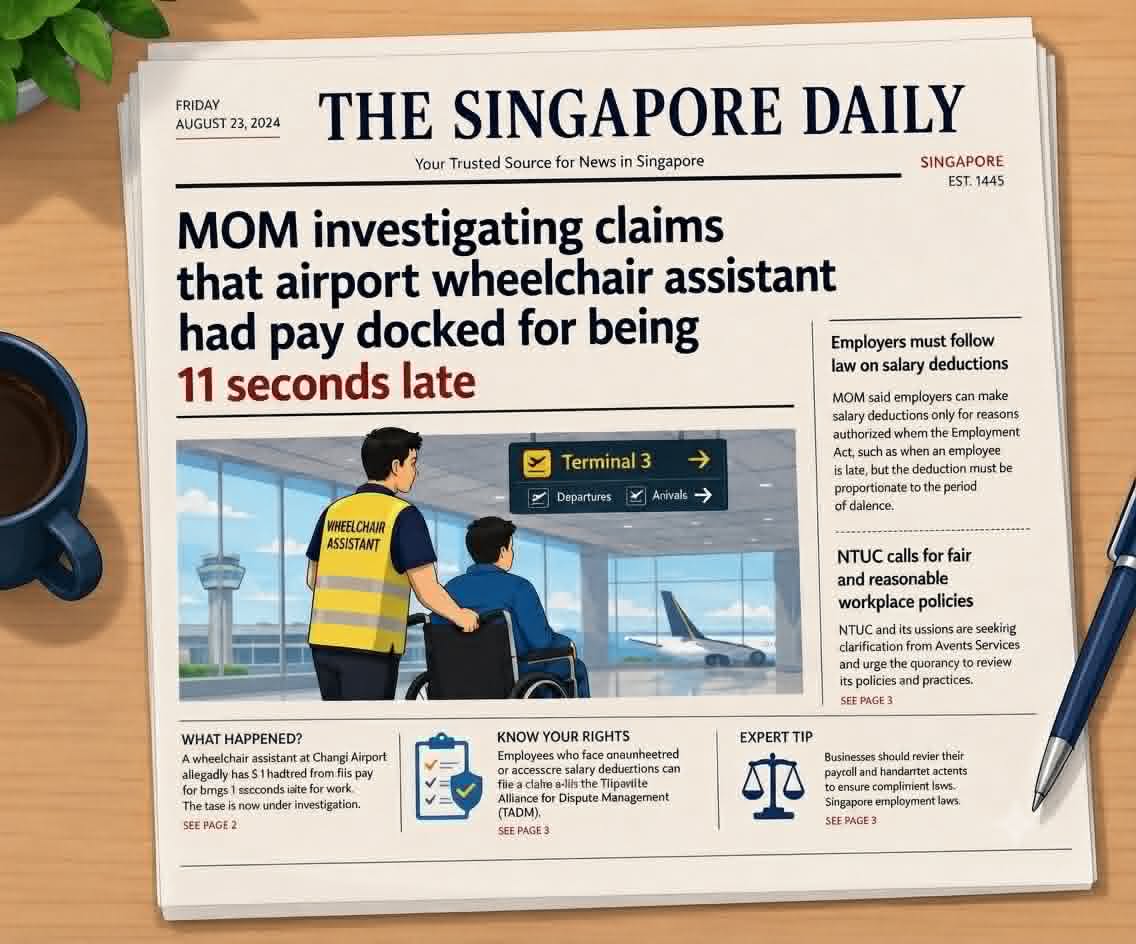
Singapore salary deduction rules are under scrutiny after the Ministry of Manpower (MOM) began investigating claims that a wheelchair assistant at Changi Airport was allegedly docked S$5 for being 11 seconds late for work.
The case has raised important questions about salary deductions, employee rights and employment compliance in Singapore. MOM has contacted Aventa Services, the employer involved, to establish the nature and extent of the alleged deduction. The ministry said it will take appropriate enforcement action if the deduction is found to be unauthorised or excessive.
What Happened at Changi Airport?
The case first attracted public attention following a LinkedIn post published on August 12 by Juliet Low, founder of Maid Without Borders Singapore.
According to the post, Low encountered a wheelchair assistant at Changi Airport who said that S$5 had been deducted from his salary because he was allegedly 11 seconds late for work.
The employee was reportedly earning approximately S$7 per hour. Low said the worker showed her a payslip indicating the alleged deduction.
The post subsequently attracted significant attention online, generating hundreds of reactions and comments.
However, the allegation should not be treated as a final finding of wrongdoing. MOM is still investigating the case, and the circumstances surrounding the deduction have yet to be fully established.
Why Are Singapore Salary Deduction Rules Important?
Singapore salary deduction rules are designed to ensure that employees are not subjected to unlawful or excessive deductions from their wages.
Under Singapore’s Employment Act, employers may make salary deductions only for authorised reasons and subject to applicable requirements.
One important example involves lateness.
MOM states that an employer may deduct salary when an employee is absent from work. However, the deduction should correspond to the period of absence.
For example, if an employee is 30 minutes late, the employer should generally deduct no more than the equivalent salary for the 30-minute period.
This principle is particularly relevant to the Changi Airport allegation.
If an employee is absent for only a very short period but suffers a substantially larger salary deduction, the employer may need to demonstrate that the deduction is legally authorised and proportionate.
Can an Employer Deduct Salary for Being Late?
Yes, an employer may be permitted to make a deduction for lateness in circumstances authorised by Singapore employment law.
However, Singapore salary deduction rules require employers to ensure that the deduction is proportionate to the employee’s period of absence.
Employers should therefore avoid treating salary deductions as automatic financial penalties.
A company’s attendance policy may require employees to arrive on time, particularly in industries where staff shortages can affect customers and business operations. However, disciplinary policies must still operate within the requirements of Singapore employment legislation.
MOM has also made clear that employers cannot simply describe a larger deduction as a “penalty” or “fine” to avoid the rules governing salary deductions.
Salary Deduction vs. Workplace Penalty
This distinction is important for employers.
A salary deduction is not automatically lawful simply because an employment contract or workplace policy refers to it as a penalty.
Employers should distinguish between:
- Salary deductions permitted by employment legislation
- Disciplinary action for misconduct
- Attendance and punctuality policies
- Financial penalties or fines
- Recovery of legitimate losses where permitted by law
Each situation may have different legal requirements.
Businesses should therefore review their employment contracts, employee handbooks and payroll procedures before implementing deductions that affect employee pay.
What Does MOM Say?
MOM has stated that employers have a duty of care and responsibility towards their employees.
The ministry is investigating the allegations involving Aventa Services and has contacted the company to establish the nature and extent of the alleged deduction.
If the deduction is found to be unauthorised or excessive, MOM may take appropriate enforcement action.
Possible consequences can include a stern warning and, in serious cases, prosecution.
This demonstrates why businesses should take payroll compliance seriously.
NTUC Calls for Fair Workplace Practices
The National Trades Union Congress (NTUC) has also sought clarification from Aventa Services.
NTUC said workers should be treated with dignity and fairness and that workplace policies should be reasonable, clearly communicated and implemented responsibly.
The organisation also highlighted the importance of proportionate salary deductions.
For isolated or minor attendance issues, employers may consider alternative measures such as:
- Counselling
- Reminders
- Attendance discussions
- Written warnings
- Other appropriate corrective measures
These measures may sometimes be more suitable than imposing a financial deduction.
What Does This Mean for Singapore Employers?
The case provides an important compliance reminder for businesses operating in Singapore.
Employers should not assume that every deduction stated in an internal policy is automatically lawful.
Instead, businesses should regularly review their payroll and employment practices.
1. Review salary deduction policies
Companies should check whether every type of salary deduction used in their payroll system is permitted under Singapore employment legislation.
Policies should be clear and easy for employees to understand.
2. Ensure deductions are proportionate
Where a deduction is permitted, employers should ensure that the amount deducted is properly calculated and proportionate to the circumstances.
This is particularly important for attendance-related deductions.
3. Maintain accurate payroll records
Employers should maintain proper salary and employment records.
Accurate records can help demonstrate how a deduction was calculated and why it was made.
They can also help resolve disputes between employers and employees.
4. Communicate workplace policies clearly
Employees should understand:
- Working hours
- Attendance requirements
- Overtime arrangements
- Salary payment procedures
- Permitted deductions
- Disciplinary procedures
Clear communication can reduce misunderstandings and workplace disputes.
5. Review automated payroll systems
Companies using automated payroll software should regularly check their system settings.
An automated deduction may still create compliance risks if the underlying policy or calculation does not comply with employment law.
Technology can improve payroll efficiency, but employers remain responsible for ensuring that payroll practices are legally compliant.
What Should Employees Do If Their Salary Is Deducted?
Employees who believe that their salary has been unlawfully or excessively deducted should first review their payslip, employment contract and relevant workplace policies.
They may also ask their employer for an explanation of the deduction.
Employees should keep supporting documents such as:
- Payslips
- Employment contracts
- Attendance records
- Salary payment records
- Emails or messages
- Written explanations from the employer
If the issue cannot be resolved directly, eligible employees may seek assistance through the Tripartite Alliance for Dispute Management (TADM).
TADM provides assistance with eligible salary-related employment claims and may help employees recover unpaid salary where a valid claim is established.
How uSafe Can Support Singapore Businesses
For companies operating in Singapore, payroll compliance should be part of a broader employment and corporate compliance strategy.
uSafe Group supports businesses with accounting, payroll, tax, corporate secretarial and other business compliance services.
Businesses can explore uSafe Singapore business services to learn more about available accounting, payroll and compliance support.
Professional payroll and accounting support can help businesses review salary calculations, maintain appropriate records and identify potential compliance issues before they develop into larger disputes.
For companies expanding into Singapore, it is also important to establish appropriate internal procedures from the beginning.
A well-structured payroll process can help businesses manage employee salaries efficiently while reducing unnecessary compliance risks.
Why Employment Compliance Matters
Employment compliance is not only about avoiding penalties.
Good employment practices can also help businesses:
- Build employee trust
- Reduce payroll disputes
- Improve workplace transparency
- Strengthen corporate governance
- Protect the company’s reputation
- Reduce regulatory risks
For employers, a small payroll issue can sometimes become a much larger reputational or employee-relations problem.
The Changi Airport case illustrates why businesses should carefully review their policies before applying financial consequences to employees.
Key Takeaways for Employers
The main lessons from the case are straightforward.
First, employers should understand and follow Singapore salary deduction rules.
Second, salary deductions should be properly authorised and proportionate to the relevant circumstances.
Third, companies should not use the term “penalty” or “fine” simply to justify a deduction that may otherwise be unauthorised.
Fourth, payroll systems and attendance policies should be reviewed regularly.
Finally, employers should communicate workplace policies clearly and provide employees with reasonable ways to raise questions about salary deductions.
Conclusion
The alleged S$5 deduction involving a wheelchair assistant at Changi Airport has highlighted important questions about Singapore salary deduction rules and employee rights.
MOM is currently investigating the allegations involving Aventa Services, and no final conclusion about the specific case should be made until the investigation is completed.
Nevertheless, the incident provides a valuable reminder for Singapore businesses. Employers should ensure that salary deductions are authorised, proportionate, transparent and properly documented.
By reviewing payroll procedures, employment policies and internal compliance controls, businesses can reduce the risk of salary disputes and create a fairer workplace.
For companies that need support with payroll, accounting and Singapore business compliance, uSafe Group can provide professional business services tailored to Singapore companies.
References and Sources
- Ministry of Manpower (MOM) – Salary Deductions
https://www.mom.gov.sg/employment-practices/salary/salary-deductions - Ministry of Manpower (MOM) – Can my employer deduct my pay for coming late to work?
https://www.mom.gov.sg/faq/salary/can-my-employer-deduct-my-pay-for-coming-late-to-work - Ministry of Manpower (MOM) – Paying Salary
https://www.mom.gov.sg/employment-practices/salary/paying-salary - Tripartite Alliance for Dispute Management (TADM) – Employment Claims
https://www.tal.sg/tadm/ - uSafe Group – Singapore Business Services
https://usafe-ca.com/services-singapore/
Disclaimer: This article is provided for general informational purposes and does not constitute legal advice. Employment laws and regulatory requirements may change. Businesses should consult the relevant Singapore authorities or qualified professionals regarding specific employment and payroll matters.


 English
  Chinese