Malaysia e-Invoice Exemption Raised to RM3 Million: What SMEs Need to Know
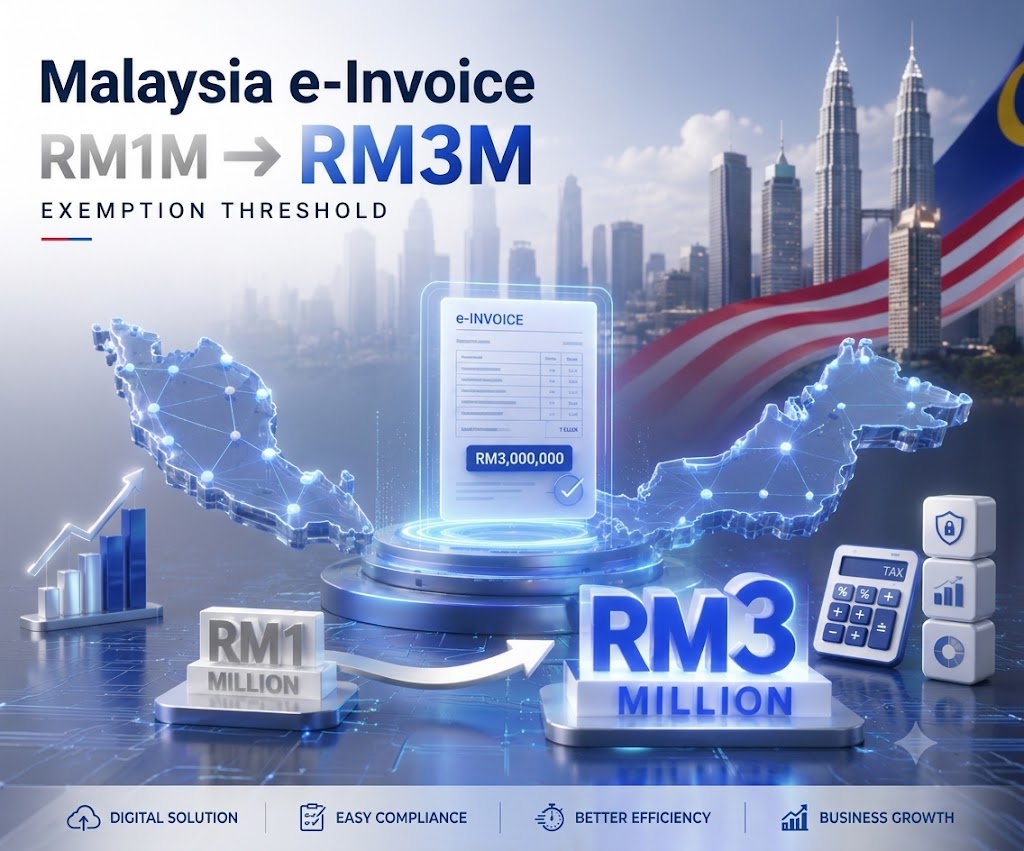
Malaysia has raised its e-Invoice exemption threshold from RM1 million to RM3 million in annual sales. Prime Minister Datuk Seri Anwar Ibrahim announced the change during his National Day 2026 address at the Putrajaya International Convention Centre (PICC) on August 30, 2026.
The announcement is important for small and medium enterprises (SMEs). Many smaller businesses have been preparing for Malaysia’s digital invoicing requirements. Now, eligible businesses with annual sales of RM3 million or less will not be required to implement e-Invoice.
As a result, the new Malaysia e-Invoice exemption provides additional flexibility for smaller businesses. It can also reduce the immediate cost and administrative pressure associated with digital invoicing.
Malaysia Raises the e-Invoice Exemption to RM3 Million
The government has agreed to increase the e-Invoice exemption threshold from RM1 million to RM3 million.
Previously, the RM1 million threshold meant that more smaller businesses could fall within the scope of e-Invoice implementation. However, the new RM3 million threshold expands the exemption.
Under the announcement, businesses with annual sales of no more than RM3 million will not be required to implement e-Invoice.
Key change
| Item | Previous position | New position |
|---|---|---|
| e-Invoice exemption threshold | RM1 million | RM3 million |
| Annual sales covered by exemption | Up to RM1 million | Up to RM3 million |
| Main impact | More businesses faced implementation | More SMEs receive relief |
Therefore, the change can provide meaningful support to smaller businesses across Malaysia.
Why Is the Malaysia e-Invoice Exemption Important?
Implementing an electronic invoicing system can require changes to a company’s existing processes.
For example, a business may need to review its accounting software, update invoice procedures and train employees. In some cases, it may also need technical support or system integration.
For a large company, these changes may be manageable. However, smaller businesses often operate with limited financial and administrative resources.
Therefore, increasing the Malaysia e-Invoice exemption threshold can reduce the immediate compliance burden.
The policy also gives smaller companies more time to understand the digitalisation process before they may eventually need to comply with future requirements.
How Will the New RM3 Million Threshold Affect SMEs?
The new threshold can affect SMEs in several ways.
1. Lower implementation costs
First, eligible businesses may avoid the immediate cost of implementing an e-Invoice system.
Depending on the company’s existing technology, implementation costs can include:
- Accounting software upgrades
- System integration
- Employee training
- Data preparation
- Professional advisory services
- Internal process changes
Consequently, SMEs may be able to allocate more resources to daily operations and business growth.
2. Reduced administrative pressure
Secondly, businesses below the exemption threshold may have fewer immediate e-Invoice compliance tasks.
This can be especially helpful for companies where the owner also manages finance and administration.
Instead of spending significant time on a new invoicing system, management can focus on customers, employees, cash flow and business development.
3. More time to prepare
The higher RM3 million e-Invoice threshold also gives smaller businesses more time to prepare.
During this period, companies can review their accounting systems and improve their financial records.
They can also learn how e-Invoice works and assess whether their existing software can support future requirements.
As a result, businesses can make a smoother transition if they eventually become subject to e-Invoice rules.
Does the RM3 Million Exemption Apply to Every Business?
Businesses should avoid assuming that the RM3 million figure automatically removes every compliance obligation.
The announcement provides an important exemption for businesses within the stated threshold. However, companies should still consider their individual circumstances and the detailed rules that apply to them.
For example, management should review:
- Annual sales or turnover
- Business structure
- Tax obligations
- Accounting records
- Related-party transactions
- Existing invoicing processes
- Future revenue expectations
In addition, companies should monitor official guidance as implementation requirements can change.
Therefore, the safest approach is to confirm the company’s position before making a compliance decision.
What Should Businesses Below RM3 Million Do Now?
The new Malaysia e-Invoice exemption does not mean that SMEs should stop paying attention to digital invoicing.
Instead, businesses can use the additional time to prepare gradually.
Review annual revenue
First, management should monitor annual sales regularly.
A company with RM2 million in annual sales today may grow significantly over the next few years. Therefore, revenue monitoring can help management identify potential future compliance obligations.
Review accounting software
Next, businesses should check their accounting systems.
Companies can determine whether their current software already supports e-Invoice functionality. If it does not, management can evaluate suitable options without rushing into an immediate implementation.
Improve financial records
Accurate financial records are also important.
Good records help businesses monitor revenue, prepare tax information and understand their financial position.
Furthermore, clean financial data can make future digitalisation easier.
Train the finance team
Although an SME may currently qualify for the exemption, finance employees can still learn about e-Invoice requirements.
Early training can reduce confusion later.
Monitor government updates
Finally, businesses should continue monitoring official announcements and guidance.
The e-Invoice exemption Malaysia framework may develop as the government continues its digitalisation programme.
Should Businesses Still Prepare for e-Invoice?
Yes. Preparation remains useful, particularly for growing businesses.
The new Malaysia e-Invoice exemption provides relief. However, it should not prevent businesses from improving their financial systems.
A company can prepare without immediately implementing a full e-Invoice system.
For example, management can start with a simple internal checklist:
- Review current annual sales.
- Monitor monthly revenue.
- Check accounting software capabilities.
- Organise customer and supplier information.
- Improve invoice records.
- Review tax and accounting procedures.
- Train relevant employees.
- Monitor official e-Invoice updates.
This gradual approach can reduce disruption in the future.
What If a Business Exceeds RM3 Million?
Businesses approaching the threshold should pay particular attention to revenue growth.
For example, a company with annual sales close to RM3 million should not wait until its revenue significantly exceeds the threshold before reviewing its systems.
Instead, management should assess its position early.
This is especially important for rapidly expanding businesses. Higher sales can be positive for the company, but growth may also create additional accounting and tax compliance responsibilities.
Therefore, businesses should treat the RM3 million e-Invoice threshold as an important planning point.
The Impact on Growing Malaysian Companies
The higher threshold may provide short-term relief, but growing companies should think beyond the current exemption.
A business may qualify for the exemption today and become subject to future requirements as its revenue increases.
For that reason, management should consider scalability when selecting accounting and financial systems.
A suitable system should support the company’s current needs while allowing it to handle higher transaction volumes later.
Moreover, businesses that operate with related companies or international customers may have additional accounting and tax considerations.
Professional advice can therefore help management understand how the new exemption fits into the wider compliance framework.
Malaysia’s Digitalisation Journey Continues
The increase in the Malaysia e-Invoice exemption threshold does not represent a move away from digitalisation.
Instead, the decision appears to provide a more flexible transition for smaller businesses.
Malaysia continues to modernise its tax administration and encourage businesses to adopt digital processes. At the same time, the government recognises that SMEs may need more time and support.
Consequently, the RM3 million exemption can create a more balanced approach.
Smaller businesses receive additional relief, while larger and growing companies can continue preparing for a more digital business environment.
What Business Owners Should Take Away
The latest announcement contains several important points for Malaysian businesses.
First, the e-Invoice exemption threshold has increased from RM1 million to RM3 million.
Second, businesses with annual sales of no more than RM3 million will not be required to implement e-Invoice under the announced measure.
Third, the change can reduce the immediate compliance burden for many SMEs.
Fourth, businesses should continue monitoring annual sales because growth can change their future compliance position.
Finally, companies should continue improving their accounting systems and financial records even if they currently qualify for the exemption.
Frequently Asked Questions About Malaysia e-Invoice Exemption
What is the new Malaysia e-Invoice exemption threshold?
The government has announced an increase in the threshold from RM1 million to RM3 million in annual sales.
Are businesses with sales of RM3 million or less required to implement e-Invoice?
According to the announcement, businesses with annual sales of no more than RM3 million will not be required to implement e-Invoice.
Why was the threshold increased?
The government said the measure aims to ease the compliance burden on smaller businesses as they adapt to digitalisation initiatives.
Does the exemption mean SMEs can ignore e-Invoice completely?
No. SMEs should continue monitoring their revenue and official guidance. A business may eventually need to comply if its circumstances change.
Should an SME below RM3 million still prepare?
Yes. Businesses can use the exemption period to improve accounting systems, organise financial records and understand future e-Invoice requirements.
What should a business approaching RM3 million do?
It should monitor revenue carefully, review its accounting system and consider professional accounting or tax advice. Early preparation can make future compliance easier.
Final Thoughts
The increase in the Malaysia e-Invoice exemption threshold from RM1 million to RM3 million is an important development for Malaysian SMEs.
For eligible businesses, the change can reduce immediate compliance costs and administrative pressure. At the same time, it gives smaller companies more time to prepare for Malaysia’s continuing digitalisation efforts.
However, businesses should not treat the exemption as a reason to ignore financial systems or future compliance.
Instead, SMEs can use this opportunity to strengthen their accounting processes, monitor revenue and prepare gradually.
For growing businesses, early preparation can make the eventual transition much easier. Therefore, the new RM3 million threshold should be viewed not only as a compliance relief measure but also as an opportunity for SMEs to build stronger financial processes for future growth.


 English
  Chinese