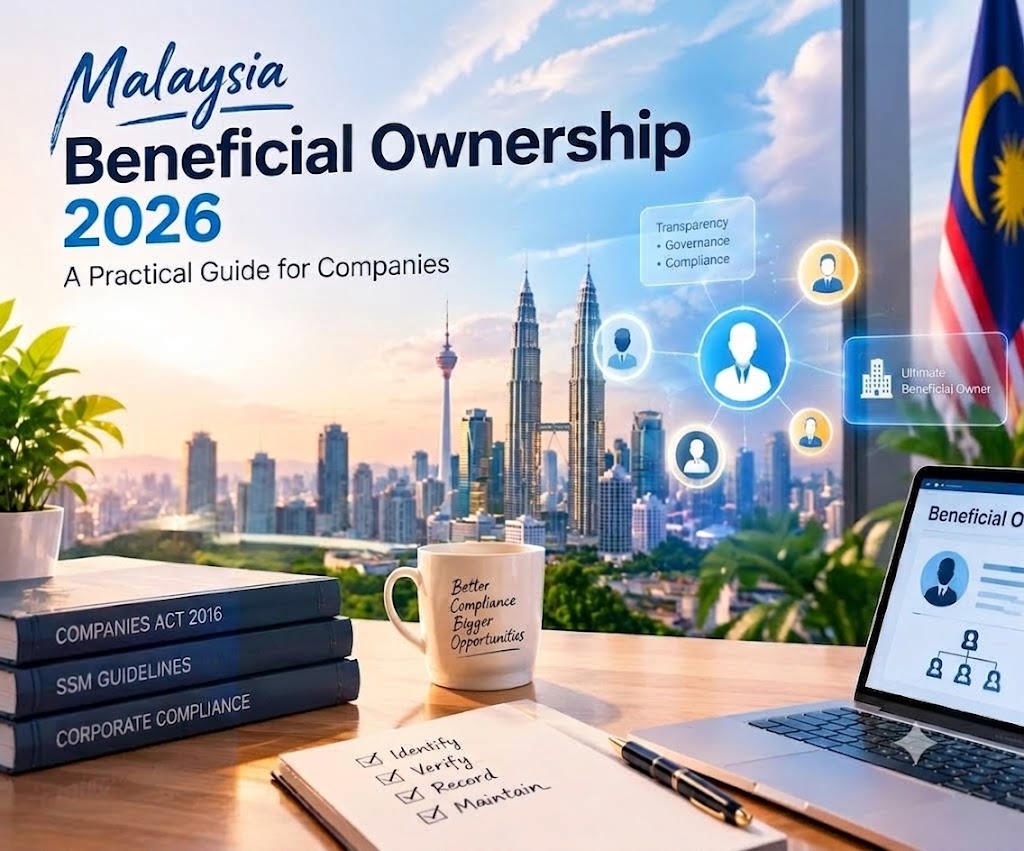
Malaysia Beneficial Ownership 2026: A Practical Guide for Companies
Malaysia beneficial ownership is an important part of corporate compliance for companies operating in Malaysia. It helps identify the individuals who ultimately own or control a company, even when ownership involves several shareholders, corporate entities or other arrangements.
For companies, this information should remain accurate, properly documented and updated when circumstances change. Malaysia’s beneficial ownership framework was strengthened through amendments to the Companies Act 2016, with the relevant beneficial ownership provisions coming into force on 1 April 2024.
This guide explains the Malaysia beneficial ownership framework, how companies can identify beneficial owners, how e-BOS works and what businesses should consider for ongoing compliance in 2026.
What Is Malaysia Beneficial Ownership?
Beneficial ownership focuses on the individual who ultimately owns or controls a company.
A registered shareholder is not necessarily the same person as the beneficial owner. For example, an individual may hold shares directly. However, ownership may also be structured through another company or through several layers of entities.
In those situations, a company needs to look beyond the immediate shareholder.
The key question is:
Who ultimately owns or exercises control over the company?
This approach helps businesses understand their ownership structure more accurately. It also supports transparency and corporate governance.
Why Is Beneficial Ownership Important in Malaysia?
Beneficial ownership information gives companies a clearer picture of who stands behind their ownership and control structure.
It can also support several important compliance objectives, including:
- Corporate transparency
- Good corporate governance
- Accurate company records
- Regulatory reporting
- Ownership verification
- Risk management
- Due diligence
- Anti-money laundering controls
For directors and company secretaries, beneficial ownership should therefore form part of the company’s wider compliance process.
The Companies Act 2016 framework requires companies to obtain, identify, verify, record and maintain beneficial ownership information. Practice Directive 9/2024 also sets out procedures for lodging beneficial ownership information through e-BOS.
Is the Shareholder Always the Beneficial Owner?
No.
A shareholder may be the beneficial owner when that individual directly owns the shares and exercises the relevant ownership or control.
However, the registered shareholder may sometimes be acting on behalf of another person.
For example:
Individual A → Company B → Company C
If Company C is the Malaysian company being reviewed, simply looking at its immediate shareholder may not provide the complete ownership picture.
The company may need to examine the ownership chain and determine the individual who ultimately owns or controls the structure.
This is why companies should not treat the shareholder register as the only source for beneficial ownership analysis.
Ownership and Control Can Be Different
Beneficial ownership is not simply a matter of looking at one percentage in the share register.
A person may have influence or control through different arrangements.
For example, control may involve:
- Direct share ownership
- Indirect ownership
- Voting arrangements
- Corporate ownership structures
- Agreements between parties
- Other forms of effective control
Therefore, companies should review the complete ownership and control structure rather than relying on a single document.
SSM provides guidelines and case studies to help companies understand how beneficial ownership should be determined.
How Does Malaysia Beneficial Ownership Work in Practice?
A practical review normally starts with the company’s current ownership structure.
The company should ask:
- Who are the registered shareholders?
- Are any shareholders companies rather than individuals?
- Who owns those corporate shareholders?
- Is there any indirect ownership?
- Who exercises effective control?
- Have there been recent changes in ownership?
- Are the company’s internal records consistent?
- Does the beneficial ownership information submitted to SSM remain accurate?
These questions can help directors and company secretaries identify potential gaps.
A company with a simple structure may complete the review relatively quickly. A group with multiple entities or jurisdictions may require a more detailed analysis.
What Is e-BOS Malaysia?
e-BOS stands for Electronic Beneficial Ownership System.
SSM provides e-BOS as an online application for updating and rectifying beneficial ownership information under the Companies Act 2016. The system is accessed through the SSM4U portal.
According to SSM, e-BOS services include:
- Adding a new beneficial owner or senior management
- Updating beneficial owner or senior management information
- Ceasing a beneficial owner or senior management
- Rectifying beneficial ownership information
SSM states that submissions are automatically approved except submissions involving rectification of beneficial ownership information.
For companies, this means beneficial ownership reporting is not simply a one-time exercise. Businesses should also consider whether previously submitted information remains correct.
SSM e-BOS official information
What Does Practice Directive 9/2024 Cover?
SSM’s Practice Directive 9/2024 provides procedures for the lodgement of beneficial ownership information under the Companies Act 2016 through e-BOS. The directive was revised in June 2024.
The directive forms part of the framework introduced alongside the beneficial ownership provisions of the Companies Act 2016.
Companies should therefore consider the following areas:
- Identifying beneficial owners
- Verifying relevant information
- Maintaining internal records
- Updating information when circumstances change
- Lodging information through the appropriate SSM system
- Keeping supporting documentation
Businesses should always check the latest SSM guidance before acting because regulatory procedures and administrative requirements can change.
What Information Should Companies Review?
A Malaysia beneficial ownership review should not focus on only one document.
Companies should consider reviewing:
Shareholder information
Check the current registered shareholders and identify whether any shareholder is a corporate entity.
Corporate structure
If another company holds shares, trace the ownership structure to understand who ultimately owns or controls that entity.
Directors and management
Review the company’s current directors and relevant senior management information where applicable.
Agreements and arrangements
Consider whether shareholder agreements or other arrangements affect ownership or control.
Previous filings
Compare internal records with information previously lodged with SSM.
Recent corporate changes
Pay particular attention to:
- Share transfers
- New shareholders
- Changes in control
- Restructuring
- New corporate shareholders
- Changes involving foreign investors
This review can help identify inconsistencies before they become larger compliance problems.
What Happens When the Beneficial Owner Is Difficult to Identify?
Some ownership structures are straightforward.
Others are not.
For example, a company may have several corporate shareholders across different jurisdictions. Some entities may also have layered ownership structures.
In these cases, the company should take reasonable steps to determine the individual who ultimately owns or controls the company.
SSM’s beneficial ownership framework includes guidance and case studies covering situations where identifying the beneficial owner can be more complicated.
The important point is that companies should document the steps they have taken rather than simply assuming that the immediate shareholder is the final answer.
What About Nominee Shareholders?
Nominee arrangements can make beneficial ownership analysis more complicated.
A nominee shareholder may appear in the company’s formal ownership records while another individual has the underlying economic interest or control.
For this reason, companies should carefully review nominee arrangements and determine whether additional information is needed to establish the true ownership and control structure.
SSM is also currently publishing consultation materials relating to proposed amendments concerning nominee shareholders and nominee directors. These consultation materials should not be treated as enacted law unless and until the relevant amendments take effect.
That distinction is important for businesses preparing their 2026 compliance processes.
Malaysia Beneficial Ownership for Foreign-Owned Companies
Foreign investors should pay particular attention to beneficial ownership.
A Malaysian company may have shareholders incorporated in Singapore, Hong Kong, the British Virgin Islands, the United Kingdom or another jurisdiction.
In these circumstances, the Malaysian company may need to look beyond the immediate corporate shareholder to understand the ownership chain.
For example:
Foreign Individual → Overseas Holding Company → Malaysian Company
The Malaysian company should consider who ultimately owns or controls the structure.
Foreign-owned companies should therefore maintain clear supporting documentation for their ownership structure.
This can also make future corporate transactions easier because directors, company secretaries, banks, auditors and professional advisers may need to understand the ownership chain.
A Malaysia Beneficial Ownership Compliance Checklist
Companies can use the following checklist as a practical starting point.
Step 1: Review shareholders
Confirm the current registered shareholders.
Step 2: Identify corporate shareholders
Check whether any shareholder is another company or legal entity.
Step 3: Trace ownership
Follow the ownership chain until the relevant individuals can be identified.
Step 4: Review control
Consider whether control exists through arrangements beyond direct share ownership.
Step 5: Verify information
Check names, identification details and other relevant information against reliable records.
Step 6: Compare internal and SSM records
Look for inconsistencies between company records and information previously lodged.
Step 7: Update when necessary
If beneficial ownership information changes, assess whether an update or notification through e-BOS is required.
SSM confirms that e-BOS provides functions for adding, updating and ceasing beneficial owners or senior management, as well as rectifying information.
Common Malaysia Beneficial Ownership Mistakes
Companies can encounter several avoidable problems.
Mistake 1: Treating the shareholder as the final owner
A registered shareholder may not be the individual who ultimately controls the company.
Mistake 2: Ignoring indirect ownership
A corporate ownership chain can hide the ultimate individual if the company reviews only its immediate shareholder.
Mistake 3: Not updating information
Ownership can change after a share transfer, restructuring or other corporate event.
Mistake 4: Keeping incomplete supporting records
A company may have submitted information but lack sufficient internal documentation explaining how the beneficial owner was identified.
Mistake 5: Treating compliance as a one-time exercise
Beneficial ownership should be reviewed when relevant changes occur.
Mistake 6: Relying on outdated guidance
Companies should use the latest SSM guidance, Practice Directives and official materials when reviewing their obligations.
SSM’s current Companies Act pages continue to list beneficial ownership guidance, Practice Directive 9/2024 and related materials.
How Beneficial Ownership Fits Into Corporate Compliance
Malaysia beneficial ownership should not operate as an isolated compliance task.
It can connect with other areas of corporate administration, including:
- Annual returns
- Company secretarial records
- Share transfers
- Corporate restructuring
- Director changes
- Foreign investment structures
- Tax compliance
- Banking due diligence
- Anti-money laundering procedures
A well-maintained corporate record makes these processes easier.
For example, a company considering a change in shareholders should consider not only the share transfer itself but also whether the change affects its beneficial ownership information.
For broader Malaysia tax compliance, businesses can also review uSafe’s resources on Malaysia transfer pricing and Malaysia withholding tax.
Malaysia Transfer Pricing: 10 Common Mistakes to Avoid
Malaysia Withholding Tax Guide
Why Accurate Beneficial Ownership Information Matters
Accurate information helps companies maintain a clearer corporate record.
It can also reduce the risk of inconsistencies between:
- Company records
- Shareholding information
- Beneficial ownership records
- Corporate documents
- Regulatory submissions
For directors and company secretaries, accurate records can make future compliance work more efficient.
It can also help when a company undergoes restructuring, brings in a new investor or changes its ownership structure.
What Should Companies Do in 2026?
Companies should take a practical approach.
First, review the current ownership structure.
Next, identify whether any ownership or control arrangements have changed.
Then, compare the company’s internal records with its beneficial ownership information.
Finally, determine whether an update or rectification is required.
Companies should use official SSM materials when assessing their obligations. SSM’s current resources include the Companies Act 2024 materials, beneficial ownership reporting framework, case studies and e-BOS information.
SSM Companies Act 2024 and Beneficial Ownership Resources
How uSafe Can Help
Beneficial ownership can become more complex when a company has multiple shareholders, foreign investors or layered corporate structures.
uSafe can support businesses with practical corporate compliance and accounting-related services in Singapore and Malaysia.
Professional support can be particularly useful when a company needs to:
- Review its ownership structure
- Understand beneficial ownership requirements
- Organise corporate records
- Review compliance processes
- Prepare for corporate changes
- Coordinate accounting and corporate compliance matters
The goal is simple: maintain accurate records and help the company stay prepared as its ownership structure changes.
Frequently Asked Questions
What is beneficial ownership in Malaysia?
Beneficial ownership refers to identifying the individual or individuals who ultimately own or control a company. The analysis may require companies to look beyond the immediate registered shareholder.
What is e-BOS Malaysia?
e-BOS is SSM’s Electronic Beneficial Ownership System. It allows companies to submit, update, cease and rectify beneficial ownership information under the Companies Act 2016.
Does every shareholder have to be the beneficial owner?
No. A registered shareholder may not always be the individual who ultimately owns or controls the company.
Do foreign-owned Malaysian companies need to consider beneficial ownership?
Yes. Foreign ownership structures can require companies to trace ownership through overseas corporate entities to identify the relevant individual or individuals.
Does beneficial ownership information need to be updated?
Companies should review their information when ownership or control changes and take the appropriate action under the applicable SSM framework.
Where can companies find official Malaysia beneficial ownership guidance?
Companies can refer to SSM’s Companies Act resources, beneficial ownership guidelines and e-BOS materials.
Conclusion
Malaysia beneficial ownership is now an important part of corporate compliance for Malaysian companies. The key issue is not simply identifying the registered shareholder. Companies should understand who ultimately owns or controls the business and maintain appropriate records to support that conclusion.
With e-BOS and the beneficial ownership framework under the Companies Act 2016, companies should treat beneficial ownership as an ongoing compliance responsibility rather than a one-time filing exercise.
For 2026, a practical approach is to review the ownership structure, verify relevant information, monitor changes and use the latest SSM guidance when updates are required.



 English
  Chinese