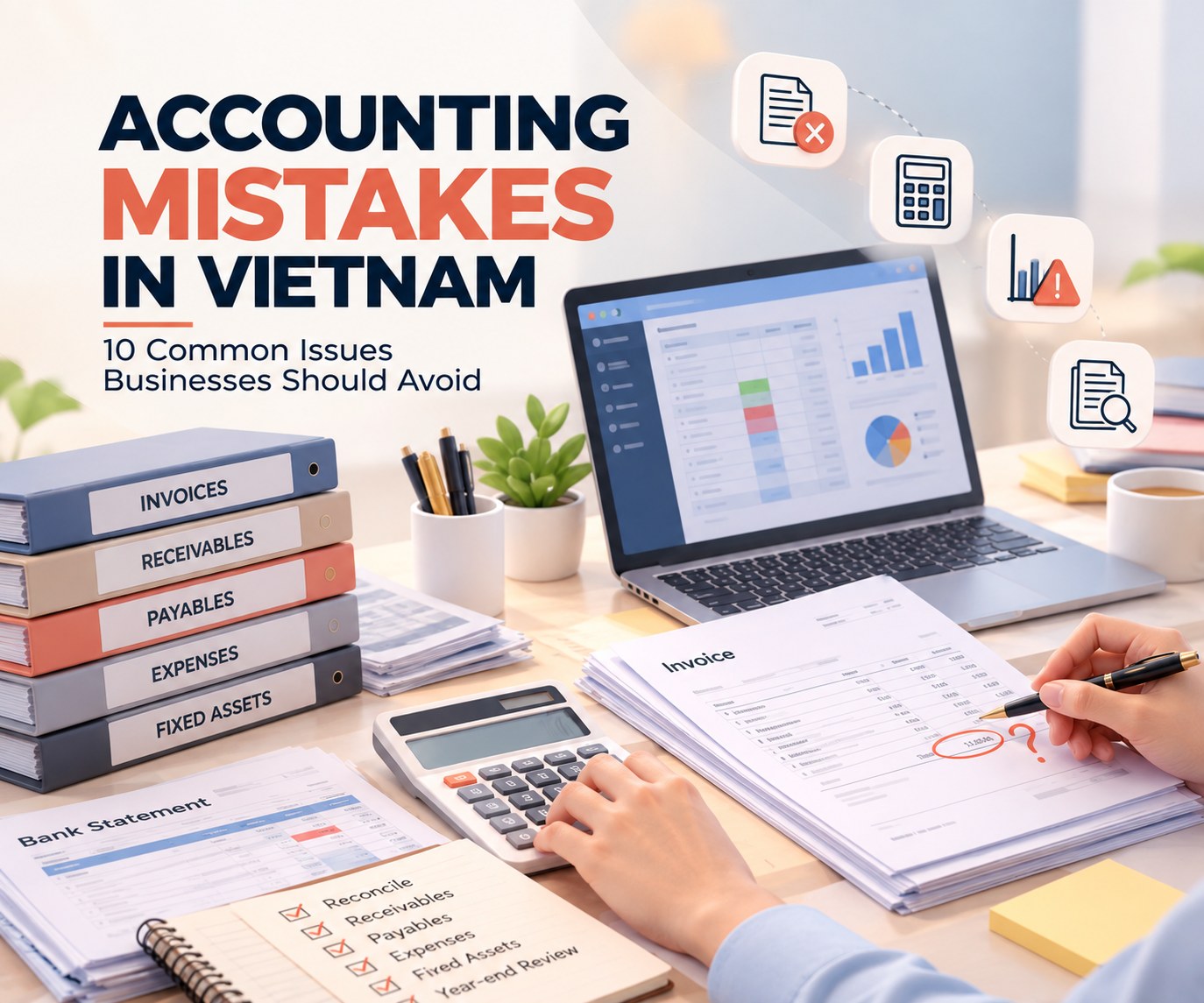
Accounting Mistakes in Vietnam: 10 Common Issues to Avoid
Running a business in Vietnam involves more than recording sales and expenses. Small accounting mistakes can gradually create larger problems, especially when financial records are incomplete, transactions are recorded incorrectly, or supporting documents are difficult to trace.
For growing companies, accounting should not be treated as a task that only happens at the end of the month or financial year. Instead, businesses need consistent processes that keep financial information accurate from the first transaction through to the final financial report.
This article highlights common accounting mistakes in Vietnam and explains practical ways businesses can avoid them.
Why Accounting Accuracy Matters in Vietnam
Accounting records provide the foundation for financial reporting, tax compliance, management decisions, and business planning.
Vietnam’s accounting framework sets requirements for accounting work, accounting documents, records, and financial reporting. Businesses should therefore maintain appropriate accounting information and supporting documentation throughout their operations.
For businesses reviewing their accounting procedures, the official Law on Accounting is an important reference point.
When accounting information is inaccurate, the impact can extend beyond the accounting department. Management may make decisions based on incorrect figures, finance teams may spend additional time correcting records, and external reviews can become more complicated.
Moreover, the problem is not always a major accounting error. In many cases, repeated small mistakes create the biggest challenges over time.
Therefore, businesses should identify potential problems early and build simple controls around their daily accounting activities.
1. Recording Transactions in the Wrong Period
One of the most common accounting mistakes in Vietnam is recording revenue or expenses in the wrong accounting period.
For example, a company may receive an invoice near the end of December but record the expense in January. Similarly, revenue may be recorded based only on when payment is received rather than considering the applicable accounting requirements.
These timing differences can affect monthly and year-end financial reports.
Businesses should also pay attention to the timing of electronic invoices. Vietnam’s rules on electronic invoices and supporting documents have been updated in recent years, including amendments to the electronic invoicing framework.
How to avoid it
Businesses should establish a clear month-end closing procedure.
Finance teams should review transactions close to the reporting date and check whether revenue, expenses, receivables, and payables have been recorded in the appropriate period.
2. Keeping Incomplete Supporting Documents
A transaction in the accounting system should be supported by appropriate documentation.
Depending on the transaction, relevant records may include:
- Invoices
- Contracts
- Payment evidence
- Delivery documents
- Approval records
- Purchase orders
- Other relevant supporting information
When documents are missing, finance teams may struggle to explain transactions later.
This is particularly important because accounting documents form the basis for recording accounting transactions. The Law on Accounting provides requirements concerning accounting documents and their management.
How to avoid it
Create a standard document checklist for different transaction types.
For example:
- Sales transactions
- Supplier purchases
- Employee expenses
- Payments
- Fixed asset purchases
- Intercompany transactions
A consistent filing structure also makes documents easier to retrieve when management, auditors, or other reviewers need them.
3. Failing to Reconcile Bank Accounts Regularly
A company may record transactions in its accounting system and still have inaccurate financial information if bank accounts are not reconciled regularly.
Differences can arise from bank charges, timing differences, unidentified payments, duplicate entries, or transactions that have not yet been recorded.
If these differences remain unresolved, they can accumulate and make the financial records more difficult to review.
How to avoid it
Bank reconciliation should be part of the normal monthly closing process.
Finance teams should compare accounting records with bank statements and investigate unexplained differences rather than simply carrying them forward to the next month.
A simple reconciliation process can help identify errors while they are still easy to correct.
4. Ignoring Outstanding Receivables
Revenue growth does not always mean healthy cash flow.
A business may report strong sales while having a significant amount of money tied up in unpaid customer invoices.
If receivables are not reviewed regularly, overdue balances can remain unnoticed for too long.
How to avoid it
Businesses should maintain an accounts receivable aging report and review overdue balances regularly.
Management can then identify:
- Long-outstanding invoices
- Disputed balances
- Customers with repeated late payments
- Unusual changes in receivables
- Amounts requiring further follow-up
This provides a clearer picture of the company’s actual cash position.
5. Not Reviewing Supplier Balances
Accounts payable can create similar problems.
Companies sometimes focus heavily on customer collections while paying less attention to supplier balances. As a result, old or incorrect supplier balances may remain in the accounting system.
Duplicate invoices, credit notes, incorrect balances, and payments that have not been matched correctly can all affect the accuracy of accounts payable.
How to avoid it
Finance teams should periodically reconcile supplier statements with the accounting records.
They should also investigate:
- Duplicate invoices
- Unrecorded credit notes
- Old unpaid balances
- Duplicate payments
- Incorrect supplier information
A clean accounts payable ledger makes month-end and year-end closing much easier.
6. Mixing Business and Personal Expenses
Small businesses sometimes use company accounts or company payment methods for expenses that are not clearly related to business activities.
This can make accounting records harder to understand and create additional questions during financial reviews.
It can also make it more difficult for management to understand the company’s actual operating costs.
How to avoid it
Businesses should establish clear expense policies and approval procedures.
Employees and business owners should understand which expenses can be charged to the company and what supporting documentation is required.
The simpler the rule, the easier it is for employees to follow.
7. Recording Fixed Assets Incorrectly
Purchasing equipment, computers, machinery, furniture, or other long-term assets requires more than simply recording the payment.
Businesses need to maintain appropriate records for fixed assets and apply the relevant accounting treatment.
Common problems include:
- Incorrect asset classification
- Missing purchase documents
- Incorrect depreciation records
- Assets that are no longer in use
- Differences between the asset register and accounting records
How to avoid it
Maintain a fixed asset register containing essential information such as:
- Acquisition date
- Purchase cost
- Asset description
- Location
- Responsible department
- Depreciation information
- Disposal status
The register should also be reviewed periodically.
This helps the finance team identify differences between physical assets and accounting records.
8. Relying Too Heavily on Accounting Software
Accounting software can reduce manual work, but software does not automatically guarantee accurate accounting.
If transactions are entered incorrectly, accounts are mapped incorrectly, or users do not understand the system, errors can still appear in financial reports.
Technology should support accounting processes rather than replace accounting judgment.
Electronic accounting and invoicing are increasingly important in Vietnam’s business environment. However, businesses still need appropriate processes for entering, checking, storing, and reviewing financial information. Current electronic invoice rules include requirements for electronic invoices and electronic documents.
How to avoid it
Businesses should establish:
- Standard transaction procedures
- User access controls
- Account mapping rules
- Review procedures
- Regular reconciliation
- Periodic checks of accounting data
This creates a stronger connection between technology and accounting processes.
9. Leaving Year-End Adjustments Until the Last Minute
Some companies only begin reviewing their accounts when the financial year is almost finished.
This can create unnecessary pressure for the finance team.
Large numbers of adjustments may need to be processed within a short period, while missing documents can become difficult to obtain.
How to avoid it
Year-end preparation should begin months before the reporting deadline.
A practical approach is to perform regular monthly reviews instead of waiting until the final month.
By doing so, businesses can identify unusual balances earlier and resolve problems gradually.
10. Not Having a Clear Accounting Review Process
Perhaps the biggest accounting mistake is assuming that recording transactions is enough.
A good accounting process should include review.
Someone should periodically ask:
- Does the balance make sense?
- Has the account changed significantly?
- Are there unexplained transactions?
- Are supporting documents available?
- Does the accounting record agree with external evidence?
- Does the current result make sense compared with previous periods?
These questions can identify problems that automated systems may not detect.
How Businesses Can Improve Their Accounting Process
Avoiding accounting mistakes in Vietnam does not necessarily require a complicated system.
In many cases, businesses can make significant improvements by strengthening a few basic processes.
Create a Monthly Closing Checklist
A standard checklist can help finance teams complete important tasks consistently.
The checklist may cover:
- Bank reconciliation
- Accounts receivable
- Accounts payable
- Inventory
- Fixed assets
- Payroll
- Expenses
- Tax-related accounts
- Management reporting
A monthly checklist also makes it easier to identify tasks that have been completed and those that still require attention.
Keep Documents Organized
Documents should be stored according to a consistent structure.
For example:
Year → Month → Transaction Type → Supporting Documents
The exact structure can vary, but consistency is essential.
Businesses should also make sure that electronic documents can be retrieved when needed.
Review Unusual Transactions
Large or unusual transactions deserve additional attention.
Instead of waiting for an external review to identify them, management can review significant transactions during the monthly closing process.
This is particularly useful for:
- Large purchases
- Unusual expenses
- Related-party transactions
- Significant adjustments
- Unusual revenue movements
Establish Clear Responsibilities
Each accounting task should have an owner.
| Process | Responsible Area |
|---|---|
| Sales recording | Accounting |
| Customer collection | Finance / AR |
| Supplier payments | Finance / AP |
| Bank reconciliation | Accounting |
| Expense approval | Management |
| Fixed asset records | Accounting / Operations |
Clear responsibilities reduce the risk of tasks being forgotten or duplicated.
When Should a Business Review Its Accounting Process?
Businesses should not wait until they discover a serious problem.
An accounting process review can be useful when:
- The company is growing quickly
- The finance team is changing
- The company opens a new branch
- Transaction volume increases
- The business introduces new accounting software
- Management reports become more complex
- A financial review identifies repeated errors
- The company prepares for an audit
- The business becomes part of a larger group
A review can help identify weaknesses before they become expensive to correct.
What Should Businesses Check Every Month?
A simple monthly review can prevent many common accounting problems.
Businesses can check:
Cash and bank accounts: Are balances reconciled?
Receivables: Are overdue customer balances being followed up?
Payables: Are supplier balances accurate?
Revenue: Are transactions recorded in the correct period?
Expenses: Are significant expenses supported by appropriate documents?
Fixed assets: Are additions and disposals properly recorded?
Documents: Can supporting records be located easily?
Unusual transactions: Are there unexpected movements that require investigation?
This approach turns accounting from a purely administrative function into an ongoing financial management process.
Building a More Reliable Accounting Process in Vietnam
Good accounting is not only about avoiding mistakes.
It is also about creating financial information that management can trust.
When transactions are recorded consistently, documents are easy to locate, accounts are reconciled regularly, and unusual balances are reviewed, the finance function becomes much more useful to the business.
For companies operating in Vietnam, this approach can also make communication between local finance teams, management, external accountants, auditors, and other stakeholders more efficient.
Final Thoughts
The most common accounting mistakes in Vietnam are often not complicated.
They may begin with a missing document, an unreconciled balance, an incorrect transaction date, or an account that has not been reviewed for several months.
However, small issues can become larger problems when they are repeated.
The solution is therefore not simply to correct mistakes after they happen. Businesses should build consistent accounting procedures, maintain reliable documentation, reconcile important balances, and review financial information regularly.
A well-organized accounting process gives management greater confidence in the numbers and creates a stronger foundation for sustainable business growth in Vietnam.
Frequently Asked Questions
What are the most common accounting mistakes in Vietnam?
Common issues include recording transactions in the wrong period, missing supporting documents, failing to reconcile accounts, incorrectly recording expenses or fixed assets, and delaying financial reviews until year-end.
How can a company reduce accounting mistakes?
Companies can reduce errors by using monthly closing checklists, reconciling key accounts regularly, maintaining organized documentation, reviewing unusual transactions, and assigning clear responsibilities.
Why is bank reconciliation important?
Bank reconciliation helps identify differences between accounting records and actual bank transactions. It can reveal missing entries, duplicate transactions, bank charges, and other discrepancies.
Should small businesses review their accounting process?
Yes. Smaller businesses can benefit significantly from simple accounting procedures because errors can have a greater impact when finance teams are small and responsibilities overlap.
How often should accounting records be reviewed?
Important accounts should generally be reviewed as part of the monthly closing process. More detailed reviews can be performed periodically based on the size and complexity of the business.
Can accounting software eliminate accounting mistakes?
No. Accounting software can automate many processes, but accurate results still depend on correct data, appropriate account mapping, user controls, and regular review.
Are electronic invoices important for businesses in Vietnam?
Yes. Electronic invoicing is an important part of Vietnam’s current tax and accounting environment. Businesses should ensure that their invoicing processes follow the applicable regulations and that electronic invoice information is properly managed and retained.
Need Help Reviewing Your Accounting Process?
If your business is experiencing recurring accounting issues, missing documentation, reconciliation problems, or difficulties during financial closing, reviewing the underlying process can be a useful first step.
A stronger accounting process can help your team spend less time correcting old mistakes and more time understanding the financial performance of the business.
Contact uSafe to discuss how your accounting process can become clearer, more consistent, and easier to manage.

 English
  Chinese