
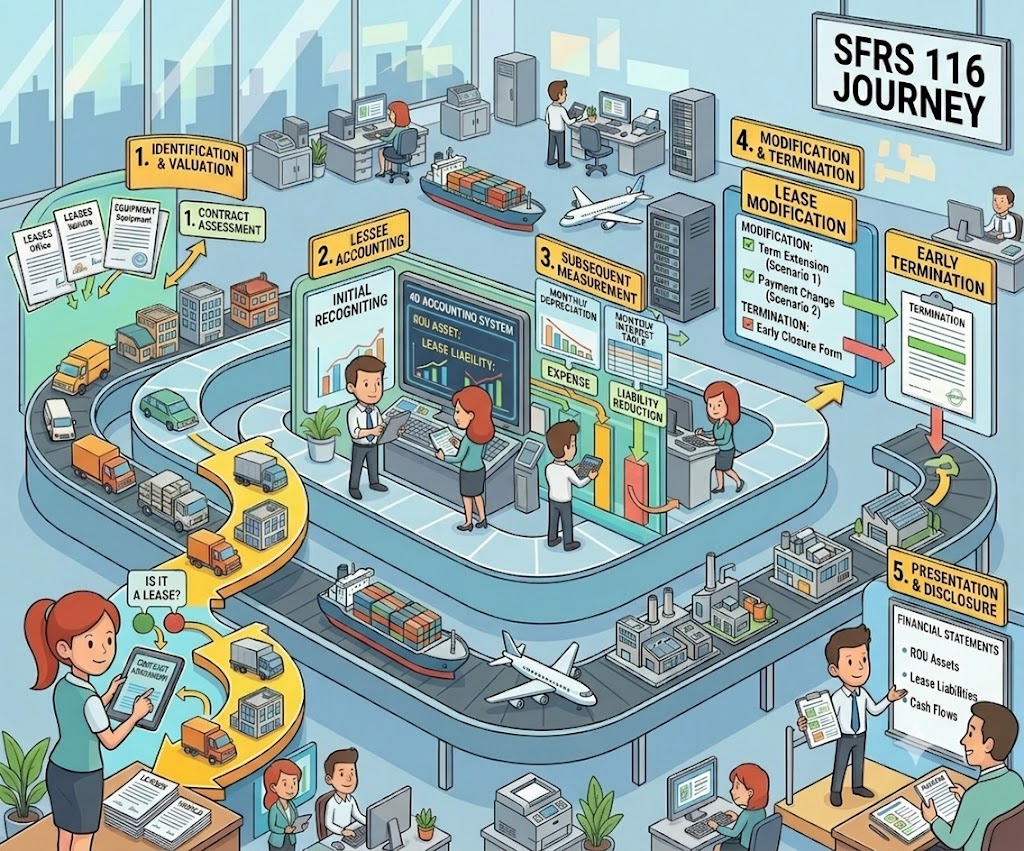
SFRS 116 Leases: A Practical Guide to Lease Accounting in Singapore
Introduction
Leasing is a common business activity in Singapore. Companies may lease offices, retail spaces, warehouses, vehicles, equipment, or other assets to support their operations. However, lease accounting under SB-FRS 116 can be more complex than simply recording monthly rental expenses.
SB-FRS 116, Leases, introduced a significant change to how lessees account for leases. In most cases, a lessee is required to recognise both a right-of-use (ROU) asset and a lease liability on the statement of financial position.
This means that understanding SB-FRS 116 is important not only for accountants and auditors, but also for business owners, finance teams and companies preparing financial statements in Singapore.
What Is SB-FRS 116?
SB-FRS 116 Leases is the Singapore Financial Reporting Standard governing the accounting treatment of leases.
The standard generally requires lessees to recognise a lease on the balance sheet, subject to specific exemptions. Instead of recognising rental expenses alone, the company normally records:
- A right-of-use asset; and
- A lease liability.
The objective is to provide users of financial statements with a clearer picture of a company’s lease commitments and financial position.
Why Is SB-FRS 116 Important?
The most important feature of SB-FRS 116 is the change from traditional operating lease accounting for lessees.
Under the previous lease accounting approach, many operating leases were recorded mainly as rental expenses in the income statement without a corresponding lease asset and liability on the balance sheet.
Under SB-FRS 116, qualifying leases are generally recognised on the balance sheet.
For businesses with significant rental commitments, this can affect:
- Total assets
- Total liabilities
- EBITDA
- Depreciation expense
- Interest expense
- Profit before tax
- Debt-related ratios
- Financial statement disclosures
Therefore, SB-FRS 116 can have a meaningful impact on both accounting records and financial analysis.
What Is a Right-of-Use Asset?
A right-of-use asset represents the lessee’s right to use an underlying asset during the lease term.
For example, imagine that a Singapore company leases an office for five years.
The company does not own the office. However, it has the contractual right to use the office during the agreed lease period.
Under SB-FRS 116, this right is generally recognised as an asset.
The ROU asset is subsequently depreciated over the applicable period, depending on the requirements of the standard.
What Is a Lease Liability?
The lease liability represents the company’s obligation to make lease payments in the future.
At the commencement of a lease, the liability is generally measured based on the present value of lease payments that have not yet been paid.
This introduces an important accounting concept:
Future lease payments → Present value → Lease liability
The liability is subsequently increased by interest and reduced when lease payments are made.
A Simple Example
Suppose a company enters into a five-year office lease.
The company agrees to make fixed annual lease payments.
Instead of simply recording each payment as rental expense, the company may need to recognise a right-of-use asset and corresponding lease liability at the lease commencement date.
Over the lease term:
ROU asset → Depreciation expense
Lease liability → Interest expense + reduction from lease payments
This means the expense profile under SB-FRS 116 can look different from a simple straight-line rental expense approach.
Are All Leases Recognised on the Balance Sheet?
Not necessarily.
SB-FRS 116 contains exemptions that may allow certain leases to be accounted for differently.
Two important exemptions relate to:
1. Short-Term Leases
Certain short-term leases may qualify for the short-term lease exemption.
2. Leases of Low-Value Assets
Certain leases involving low-value underlying assets may also qualify for an exemption.
Companies should assess the relevant requirements carefully rather than automatically applying an exemption to every small or short lease.
What Makes SB-FRS 116 Challenging?
The difficult part is often not the initial journal entry.
The real challenge is identifying and managing all lease-related information throughout the contract lifecycle.
Businesses may need to determine:
- Whether a contract contains a lease
- The lease commencement date
- The lease term
- Lease payments
- Renewal or termination options
- Discount rates
- Lease modifications
- Variable lease payments
- ROU asset measurements
- Lease liability movements
- Required disclosures
For companies with many leases, maintaining this information manually can increase the risk of accounting errors.
Lease Term: A Key Area to Watch
Determining the lease term can require professional judgement.
A contract may include options to extend or terminate the lease.
The company therefore needs to consider whether it is reasonably certain to exercise an extension option or reasonably certain not to exercise a termination option, based on the circumstances and requirements of SB-FRS 116.
This can become particularly important for long-term property leases.
Lease Modifications
A lease does not necessarily remain unchanged throughout its entire contractual period.
For example, a company may:
- Expand its office space
- Reduce leased space
- Change rental payments
- Extend the lease period
- Change contractual terms
Such changes may result in a lease modification.
The accounting treatment depends on the nature and circumstances of the modification.
How SB-FRS 116 Can Affect Financial Ratios
One of the most interesting aspects of SB-FRS 116 is its potential impact on financial analysis.
Recognising lease liabilities can increase reported liabilities, while recognising ROU assets increases reported assets.
As a result, companies may see changes in ratios such as:
- Debt-to-equity ratio
- Asset turnover
- Return on assets
- Current ratio
- EBITDA-related measures
This is particularly relevant when management, investors, lenders or other stakeholders compare financial performance across companies.
SB-FRS 116 and EBITDA
For many businesses, EBITDA is an important performance indicator.
Under a traditional operating lease model, rental expenses may have been included in operating expenses.
Under SB-FRS 116, the accounting presentation for lessees generally separates the depreciation of the ROU asset and interest on the lease liability.
Consequently, EBITDA can increase compared with the previous operating lease presentation, even though the underlying cash payments have not necessarily changed.
This is why financial statement users should understand the accounting impact before interpreting changes in EBITDA.
What Should Singapore Businesses Do?
Companies should not wait until year-end to review their lease accounting.
A practical SB-FRS 116 process can include:
- Identify all lease contracts.
- Determine whether each contract contains a lease.
- Identify the lease commencement date.
- Determine the lease term.
- Identify fixed and relevant variable payments.
- Determine the appropriate discount rate.
- Calculate the initial lease liability.
- Recognise the right-of-use asset.
- Record subsequent depreciation and interest.
- Review modifications and reassessments.
- Prepare the required financial statement disclosures.
- Maintain supporting documentation for audit purposes.
SB-FRS 116 and Audit
Lease accounting is also an important area for financial statement audits.
Auditors may examine whether:
- Lease contracts have been completely identified.
- Lease terms are properly determined.
- Lease payments are accurately captured.
- Discount rates are reasonable and appropriately supported.
- ROU assets are correctly measured.
- Lease liabilities are correctly calculated.
- Modifications are properly accounted for.
- Financial statement disclosures are complete.
A strong lease accounting process can therefore make the audit process more efficient and reduce the risk of unexpected adjustments.
Final Thoughts
SB-FRS 116 is more than a technical accounting standard. It can influence how Singapore businesses present their assets, liabilities, expenses and financial performance.
For companies with significant property, equipment or other lease arrangements, understanding SB-FRS 116 early can help management improve financial reporting, prepare for audits and make better financial decisions.
The key is not simply to calculate the lease liability once. Businesses should establish a reliable process for identifying, measuring, monitoring and reassessing leases throughout their lifecycle.
For companies that are unsure whether their existing lease accounting complies with SB-FRS 116, obtaining professional accounting or audit advice can help identify potential issues before they affect the financial statements.
References and Sources
1. Accounting and Corporate Regulatory Authority (ACRA) – Guide to Accounting Standards
The Accounting and Corporate Regulatory Authority (ACRA) provides information on Singapore’s financial reporting frameworks, including the Singapore Financial Reporting Standards (SFRS), SFRS(I)s and related accounting standards issued by the Accounting Standards Council (ASC).
ACRA – Guide to Accounting Standards
2. IFRS Foundation – IFRS 16 Leases
The IFRS Foundation provides the official overview of IFRS 16 Leases, including the recognition of right-of-use assets and lease liabilities, lease exemptions, measurement and presentation requirements.
IFRS Foundation – IFRS 16 Leases
3. IFRS Foundation – IFRS 16 Supporting Materials
This page provides official implementation resources for IFRS 16, including educational materials, webinars and IFRS Interpretations Committee agenda decisions relating to leases.
IFRS Foundation – IFRS 16 Supporting Materials
4. IFRS Foundation – IFRS 16 Standard
The official IFRS 16 standard sets out principles for the recognition, measurement, presentation and disclosure of leases. It also explains exemptions for short-term leases and leases of low-value assets.
IFRS 16 Leases – Official Standard
5. IFRS Foundation – IFRS 16 Project Summary and Feedback Statement
This publication explains the key changes introduced by IFRS 16, including the single lessee accounting model, recognition of lease assets and liabilities, and separate presentation of depreciation and interest.
IFRS 16 Project Summary and Feedback Statement
6. IFRS Foundation – IFRS 16 Post-implementation Review
In July 2026, the IASB concluded that IFRS 16 is overall working as intended. The Board also decided to explore ways to reduce the ongoing costs associated with certain lease measurement requirements.
IFRS 16 Post-implementation Review
7. IFRS Foundation – IASB July 2026 Update
The July 2026 IASB update provides the latest information on the Post-implementation Review of IFRS 16 and the Board’s decisions regarding future research and possible improvements.
Recommended Citation
For a professional Singapore accounting article, readers should refer primarily to the Singapore accounting standards issued by the Accounting Standards Council (ASC) through ACRA, together with the corresponding IFRS Foundation materials.
Note: This article is provided for general informational purposes and should not be treated as a substitute for professional accounting, audit or financial reporting advice.


 English
  Chinese