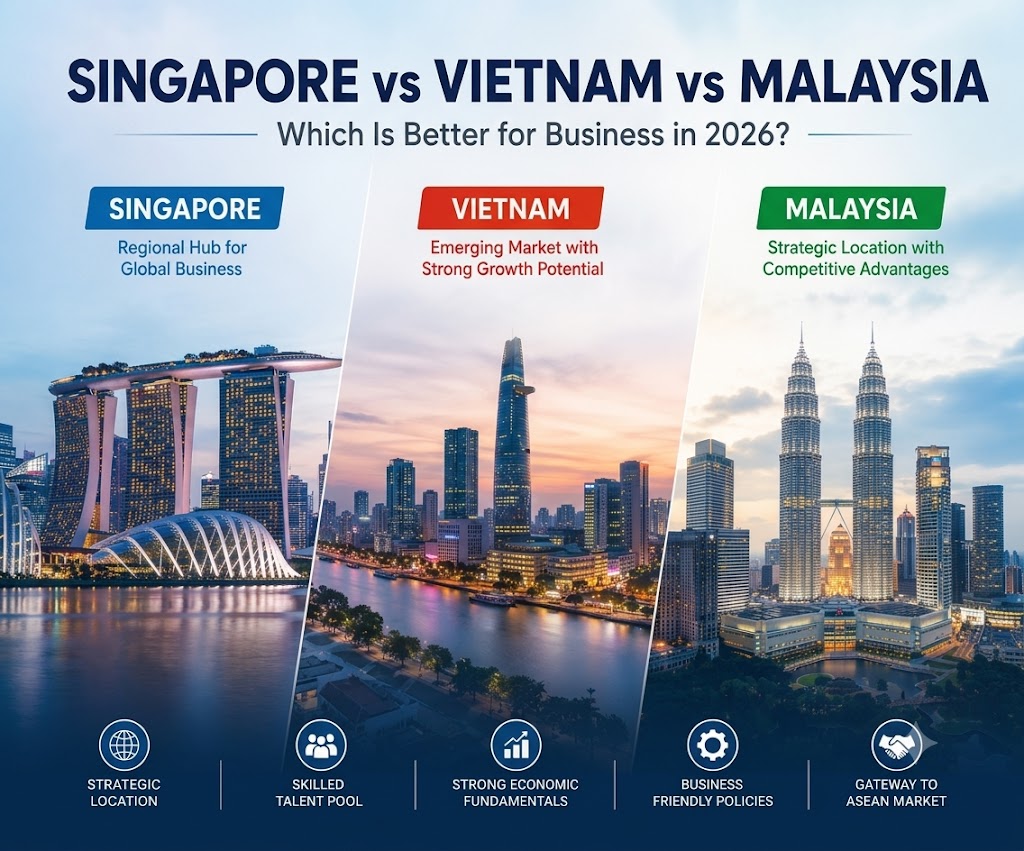
Singapore vs Vietnam vs Malaysia: Which Is Better for Business in 2026?
Choosing the right country can shape your company’s growth. For many investors, the Singapore vs Vietnam vs Malaysia decision has become an important part of an ASEAN expansion plan.
Each market offers different advantages. Singapore provides a strong base for regional headquarters, finance, professional services, and international operations. Vietnam combines a large consumer market with strong manufacturing opportunities. Meanwhile, Malaysia offers established infrastructure, manufacturing capabilities, and regional connectivity.
So, which country is better for your business in 2026?
The answer depends on your goals. Your industry, customers, workforce, budget, tax position, and expansion plans all matter. Therefore, businesses should compare several factors before choosing a market.
This guide compares Singapore, Vietnam, and Malaysia across company setup, operating costs, manufacturing, services, tax, and regional expansion.
Important: This article provides general business information. Foreign investment, ownership, licensing, tax, employment, and company registration rules can vary by industry and structure. Always obtain professional advice before making an investment decision.
Singapore vs Vietnam vs Malaysia: Quick Comparison
A quick comparison can help you understand the main differences.
| Business factor | Singapore | Vietnam | Malaysia |
|---|---|---|---|
| Regional headquarters | Excellent | Good | Good |
| Consumer market | Smaller | Large | Medium |
| Manufacturing | Advanced and specialised | Strong | Strong |
| Financial services | Excellent | Growing | Strong |
| Infrastructure | Excellent | Developing rapidly | Strong |
| Operating costs | Higher | Generally lower | Moderate |
| ASEAN connectivity | Excellent | Strong | Excellent |
| Professional services | Excellent | Growing | Strong |
| Regional role | HQ and international services | Market and production | Operations and manufacturing |
This table provides a general starting point. However, your business model should determine the final choice.
Why Choose Singapore for Business?
Singapore remains a major business hub in Southeast Asia.
In particular, the country offers strong infrastructure, international connectivity, financial services, and professional expertise. These advantages can help companies manage operations across several ASEAN markets.
Foreign businesses also have several ways to establish a presence. According to ACRA, foreign businesses can set up a representative office, register a subsidiary or local company, register a branch, or use re-domiciliation when they meet the relevant conditions.
Each option serves a different purpose.
For example, a subsidiary creates a separate Singapore company. A branch extends the foreign company’s operations into Singapore. In contrast, a representative office can support market research but cannot conduct income-generating activities.
Foreign entrepreneurs also need to consider local requirements. ACRA states that foreigners must engage a Corporate Service Provider to reserve a name and register a business. They must also meet the applicable local residency requirements.
Singapore may suit your business if:
- You need a regional headquarters.
- You serve international customers.
- You operate in professional or financial services.
- You manage several ASEAN markets.
- You value strong infrastructure.
- You need an established corporate environment.
However, Singapore usually has higher operating costs than some neighbouring markets.
Therefore, companies that depend on large-scale production or lower-cost operations should compare Vietnam and Malaysia as well.
Why Choose Vietnam for Business?
Vietnam offers a different opportunity for international investors.
First, the country provides access to a large and growing consumer market. Enterprise Singapore reports a population of about 101 million in 2024 and highlights Vietnam’s expanding consumer market and manufacturing landscape.
The manufacturing sector also creates opportunities for foreign companies. As a result, businesses can consider Vietnam for production, sourcing, technology, logistics, and local sales.
Foreign investors have several investment options. For instance, they may establish a 100% foreign-owned enterprise, form a joint venture, acquire shares, pursue an M&A transaction, or establish a representative office.
The right structure depends on the business activity.
Furthermore, some sectors have specific conditions for foreign investors. Investors should therefore check licensing, ownership, and investment requirements before committing capital.
Vietnam may suit your business if:
- You want access to a large consumer market.
- Manufacturing forms part of your strategy.
- You need a larger workforce.
- You plan to develop local operations.
- You want to diversify your supply chain.
- Your products target Vietnamese customers.
Vietnam can offer strong growth opportunities. Nevertheless, investors should consider accounting, tax, employment, licensing, and management requirements as part of the total cost.
Why Choose Malaysia for Business?
Malaysia provides another attractive option for ASEAN expansion.
The country combines infrastructure, manufacturing, services, logistics, and regional supply-chain opportunities. In addition, its connection with Singapore can create opportunities for companies that want to operate across both markets.
The Johor-Singapore Special Economic Zone adds another dimension to this relationship. Businesses can explore opportunities that combine Singapore’s business and financial strengths with Johor’s land and operating capacity.
Malaysia also has a clear corporate registration framework. According to the Companies Commission of Malaysia, a private company generally needs at least one director who ordinarily resides in Malaysia and at least one promoter.
Therefore, foreign investors should understand the local structure before starting the incorporation process.
Malaysia may suit your business if:
- You need manufacturing capacity.
- You depend on regional supply chains.
- You want an operating base in ASEAN.
- Logistics form an important part of your business.
- You want established infrastructure.
- You want to balance operating costs and business capabilities.
At the same time, businesses should review industry-specific rules before choosing Malaysia.
Singapore vs Vietnam vs Malaysia for Company Setup
Company registration is only the beginning of market entry.
Singapore offers several structures for foreign businesses. A foreign company can use a subsidiary, branch, representative office, or re-domiciliation when the relevant conditions apply.
Vietnam also offers several routes. Investors can establish a new enterprise, invest in an existing business, form a joint venture, acquire shares, or use other permitted structures.
Malaysia follows its own incorporation framework. A private company needs at least one director who ordinarily resides in Malaysia, while the incorporation process also requires an approved company name.
For this reason, businesses should compare more than registration fees.
Consider the following factors:
- Foreign ownership.
- Company structure.
- Local director requirements.
- Registered office requirements.
- Business licences.
- Bank account requirements.
- Accounting obligations.
- Tax registration.
- Employment rules.
- Annual compliance.
A low incorporation cost does not necessarily mean a low total business cost.
Which Country Has the Lowest Business Costs?
Operating costs can influence the final decision.
Vietnam often attracts companies that need competitive production and labour costs. This advantage can matter greatly for manufacturing and labour-intensive operations.
Malaysia can provide another cost-conscious option. Its infrastructure and industrial base can support businesses that need more than a simple low-cost location.
Singapore normally costs more. Nevertheless, companies may accept the additional expense because they value financial services, infrastructure, connectivity, and professional expertise.
Therefore, businesses should calculate total operating costs instead of comparing registration fees alone.
Include salaries, rent, logistics, accounting, tax, compliance, technology, and professional services in the calculation.
A cheaper market may create higher logistics costs. Conversely, a more expensive location may provide benefits that support faster growth.
Which Country Is Better for Manufacturing?
Manufacturing can significantly change the answer.
Vietnam has developed a strong manufacturing ecosystem. Enterprise Singapore describes the country as having a vibrant manufacturing landscape supported by a young and abundant workforce.
Malaysia also offers established manufacturing capabilities and supply-chain infrastructure.
Singapore takes a different position. The country focuses more heavily on advanced manufacturing, technology, logistics, research, and high-value activities.
As a result, companies seeking large-scale production may prefer Vietnam or Malaysia. Meanwhile, businesses that need advanced manufacturing or regional management may find Singapore more suitable.
Which Country Is Better for a Regional Headquarters?
Singapore often stands out for regional headquarters.
A company can use its Singapore entity to coordinate management, finance, contracts, business development, and regional strategy.
For example, a group could maintain its regional headquarters in Singapore while operating production in Vietnam and sales activities in Malaysia.
This structure can separate regional management from local operations.
However, multiple entities create additional administrative work.
Each company may need accounting, tax reporting, payroll, banking, corporate records, and compliance support.
Therefore, businesses should create additional entities only when the commercial benefits justify the extra responsibilities.
Which Country Is Better for Services and Finance?
Singapore has a strong position in international services and finance.
Professional services, financial activities, technology companies, and regional management teams can benefit from its mature business ecosystem.
Malaysia also provides opportunities for shared services, technology, logistics, and regional operations.
Meanwhile, Vietnam continues to develop its technology and service sectors.
For instance, a company may place its regional management function in Singapore while using Vietnam for technology development and Malaysia for operational support.
This approach can work well for businesses with a clear regional strategy.
Nevertheless, management should review the tax and compliance implications before implementing a multi-country structure.
Singapore vs Vietnam vs Malaysia for Tax and Compliance
Tax and compliance should form part of the expansion plan from the beginning.
Each country has its own tax system, accounting requirements, employment rules, filing obligations, and licensing framework.
Furthermore, cross-border groups must consider related-party transactions.
For example, a Singapore headquarters may charge management fees to a Vietnam subsidiary. Another group may purchase goods from a Malaysian related company.
These transactions require proper documentation and careful tax analysis.
In addition, companies with operations in multiple countries should review transfer pricing and applicable tax treaties.
Consequently, a regional accounting and tax plan can help management control risks before transactions become complicated.
Can One Business Use Singapore, Vietnam, and Malaysia?
Yes. A larger group may use all three markets when the business model supports it.
One possible structure could look like this:
Singapore
Regional headquarters, finance, management, and international services.
Vietnam
Manufacturing, technology development, local sales, and market expansion.
Malaysia
Logistics, manufacturing, shared services, and regional operations.
This approach can combine the strengths of several markets.
However, every additional entity increases administrative requirements.
Management must consider accounting, tax, payroll, banking, reporting, and local compliance in each jurisdiction.
For that reason, businesses should establish a clear commercial purpose before creating another entity.
Common Mistakes When Expanding in Southeast Asia
International expansion can create significant opportunities. However, poor planning can also increase costs.
Choosing a Country Only Because It Is Cheaper
Low operating costs do not guarantee better results.
Instead, compare the complete cost of running the business.
Ignoring Industry-Specific Rules
A manufacturer may face different requirements from a technology company.
Likewise, financial services businesses can face stricter regulatory requirements.
Therefore, investors should review rules for their specific activity.
Focusing Only on Company Registration
Registration represents only one part of market entry.
Businesses also need accounting, tax, banking, employment, licences, and ongoing compliance.
Creating Companies Too Early
Multiple entities increase administrative work.
Therefore, management should establish a clear commercial reason before creating a new subsidiary.
Ignoring Cross-Border Transactions
Management fees, royalties, dividends, loans, and related-party purchases can create tax and accounting considerations.
For this reason, companies should plan these transactions before operations begin.
Treating ASEAN as One Market
Singapore, Vietnam, and Malaysia have different legal and regulatory systems.
As a result, a regional strategy still requires country-specific planning.
A Practical Decision Framework
Choosing the right market becomes easier when you focus on your main objective.
Choose Singapore if:
Your priority involves regional headquarters, international clients, finance, professional services, or corporate management.
Choose Vietnam if:
Your strategy focuses on manufacturing, workforce scale, local consumers, technology development, or market growth.
Choose Malaysia if:
You need manufacturing, logistics, shared services, infrastructure, or regional operations.
Consider Multiple Markets if:
Your business has enough scale to support separate entities and compliance systems.
Ultimately, the best structure should follow the business strategy.
How uSafe Can Support Your ASEAN Expansion
Expanding across Southeast Asia involves more than registering a company.
Businesses also need reliable accounting, financial reporting, tax support, audit services, and corporate compliance.
uSafe provides professional accounting, audit, tax, and corporate advisory services in Singapore.
For businesses planning regional expansion, a structured approach can simplify administration.
First, management can identify the commercial objective. Next, the business can compare markets, entity structures, tax considerations, accounting requirements, and compliance responsibilities.
After that, management can choose a structure that matches the company’s current stage.
As the business grows, the group can review its structure and make changes when commercial needs evolve.
This approach can help businesses maintain better control over regional operations.
Final Checklist Before Expanding
Before choosing Singapore, Vietnam, or Malaysia, ask these questions:
- Where are your customers?
- Where will you hire employees?
- Do you need manufacturing?
- Do you need a regional headquarters?
- How important are operating costs?
- What licences does your industry require?
- What foreign ownership rules apply?
- How will you manage cross-border transactions?
- What accounting and tax obligations will apply?
- Do you need one entity or several?
- Can your management team handle additional compliance?
Answering these questions can make the decision clearer.
Singapore vs Vietnam vs Malaysia: Final Verdict
There is no universal winner in the Singapore vs Vietnam vs Malaysia comparison.
Singapore can provide a strong base for regional headquarters, finance, professional services, and international operations. Vietnam can offer opportunities for manufacturing, workforce expansion, technology, and consumer-market growth. Malaysia can support manufacturing, logistics, services, and regional operations.
Therefore, businesses should choose based on their actual objectives.
If regional management is the priority, Singapore may be the strongest fit. If manufacturing and market expansion matter most, Vietnam may deserve closer attention. Meanwhile, Malaysia can suit companies that want a combination of infrastructure, operations, manufacturing, and ASEAN connectivity.
Most importantly, do not choose a country based on one tax rate or registration fee.
Instead, compare customers, workforce, infrastructure, logistics, tax, licensing, accounting, and long-term growth potential.
With careful planning, a business can build a structure that supports sustainable growth across Southeast Asia.
Planning to expand across Singapore, Vietnam, or Malaysia? Contact uSafe to discuss your accounting, audit, tax, and corporate compliance needs.
Official Sources
- Accounting and Corporate Regulatory Authority (ACRA), Singapore
- Enterprise Singapore – Vietnam Business Guide
- Enterprise Singapore – Vietnam Market Overview
- Enterprise Singapore – Malaysia Business Guide
- Companies Commission of Malaysia (SSM)


 English
  Chinese