
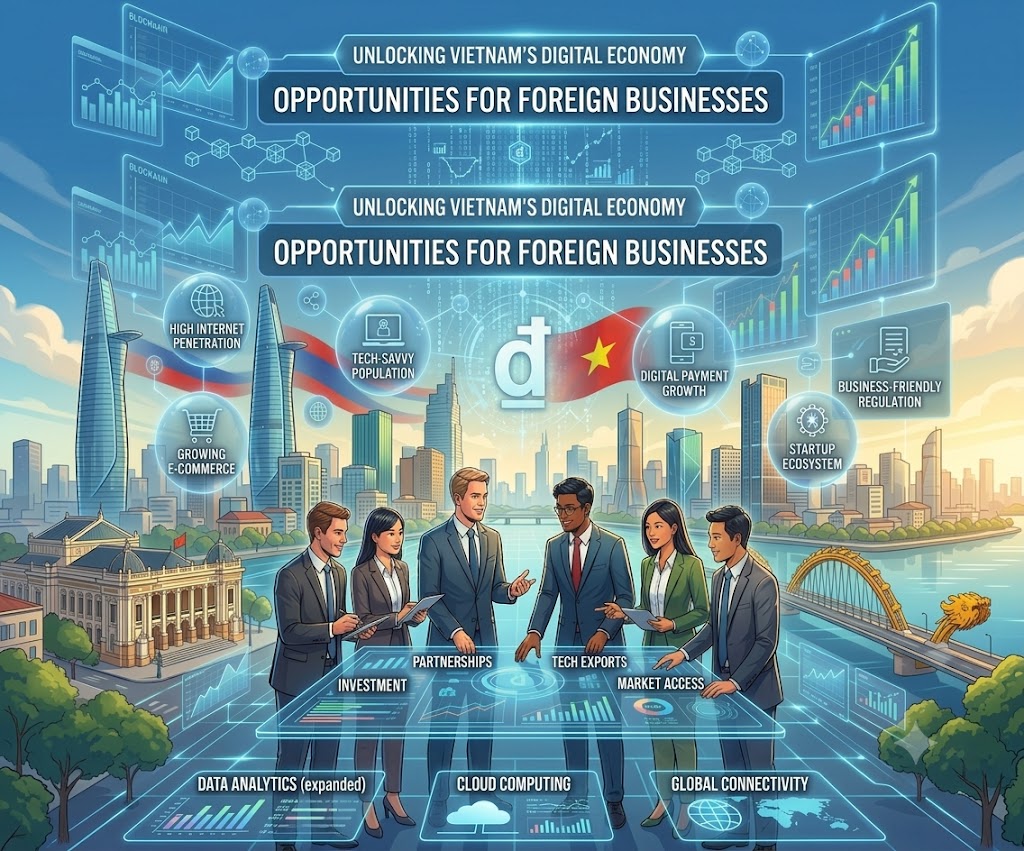
Vietnam’s Digital Economy: Opportunities for Foreign Businesses
Vietnam’s digital economy is developing rapidly and creating new opportunities for international businesses. Today, technology is changing how companies sell products, manage operations, serve customers, and enter new markets.
In particular, Vietnam is becoming more than a traditional manufacturing destination. The country is also developing a growing digital ecosystem that includes e-commerce, digital payments, software, artificial intelligence, cloud services, logistics, and online platforms.
At the same time, digital transformation is becoming an important priority for both businesses and the Vietnamese government. As technology adoption increases, foreign companies can explore new ways to enter the Vietnamese market and build long-term business opportunities.
Therefore, understanding Vietnam’s digital economy can help international investors make better decisions before entering the market.
This guide explains the major trends, opportunities, challenges, and practical considerations for foreign businesses interested in Vietnam’s digital economy.
What Is Vietnam’s Digital Economy?
Vietnam’s digital economy refers to economic activities that use digital technologies, online platforms, electronic transactions, software, data, and digital infrastructure.
In simple terms, it includes businesses that use technology to create, sell, deliver, or manage products and services.
The sector covers many areas, including:
- E-commerce and online retail
- Digital payments and financial technology
- Software and IT services
- Cloud computing
- Artificial intelligence
- Digital marketing
- Online education
- Digital logistics
- Technology-enabled manufacturing
- Data analytics
- Online business platforms
- Cross-border digital services
Moreover, digital technology is increasingly connected to traditional industries. For example, manufacturers can use automation to improve production, while retailers can use e-commerce platforms to reach customers.
As a result, Vietnam’s digital economy is not limited to technology companies. Instead, it creates opportunities across many different industries.
Why Is Vietnam’s Digital Economy Growing?
Several factors are supporting the growth of Vietnam’s digital economy. Furthermore, changing consumer behavior and increasing business investment are accelerating digital adoption.
1. A Growing Digital Consumer Market
Vietnam has a large consumer market with rapidly increasing digital activity. For example, consumers increasingly use smartphones and online platforms to search for products, communicate with businesses, make payments, and complete purchases.
Consequently, companies can use digital channels to reach customers more efficiently.
The growth of online retail also demonstrates this trend. Vietnam’s e-commerce sector has become an important part of the wider retail market.
In addition, social media and livestream commerce are giving businesses new ways to promote products and interact directly with customers.
For foreign companies, this creates opportunities to combine international products with localized digital marketing strategies.
2. Rapid E-Commerce Development
E-commerce is one of the most visible parts of Vietnam’s digital economy.
Today, consumers can purchase products through marketplaces, brand websites, social media, and other online channels. Meanwhile, businesses are investing in technology to improve their online sales and customer experience.
The Vietnamese government has also continued to support e-commerce development. As a result, online businesses can expect continued changes in areas such as digital payments, electronic invoicing, logistics, and online transactions.
Foreign companies can potentially provide:
- E-commerce platforms
- Payment solutions
- Digital marketing services
- Logistics technology
- Warehouse management systems
- Customer relationship tools
- Cybersecurity services
- E-commerce consulting
Therefore, e-commerce can provide opportunities for both international retailers and companies that support online businesses.
3. Increasing Demand for Digital Technology
Vietnamese businesses are also investing in digital tools to improve productivity and competitiveness.
For instance, companies may adopt cloud software, accounting systems, data analytics, artificial intelligence, and cybersecurity solutions.
Furthermore, businesses in manufacturing, retail, finance, logistics, and professional services are increasingly looking for technology that can reduce costs and improve decision-making.
Potential areas include:
- Enterprise software
- Cloud computing
- Artificial intelligence
- Business intelligence
- Cybersecurity
- Digital accounting
- Customer management
- Supply-chain technology
As a result, foreign technology providers can target both large companies and growing Vietnamese businesses.
Key Opportunities for Foreign Businesses
Vietnam’s digital economy offers opportunities across several industries. However, the right opportunity depends on each company’s products, target customers, investment strategy, and regulatory requirements.
E-Commerce and Digital Retail
Vietnam’s expanding e-commerce market provides opportunities for international brands and technology companies.
For example, foreign businesses can sell through online marketplaces or develop their own digital sales channels.
They can also provide supporting services such as:
- E-commerce software
- Online advertising
- Payment technology
- Customer service platforms
- Logistics solutions
- Digital analytics
In addition, international companies can combine e-commerce with regional supply chains and manufacturing operations.
This approach can help businesses serve Vietnamese consumers while also developing a wider Southeast Asian strategy.
Financial Technology and Digital Payments
Digital payments are becoming increasingly important in Vietnam.
For example, consumers and businesses can use mobile banking, QR payments, electronic payment platforms, and other digital financial services.
As a result, foreign companies with expertise in financial technology may find opportunities in areas such as:
- Payment technology
- Financial software
- Fraud prevention
- Digital banking
- Business payment systems
- Financial data solutions
Nevertheless, financial services can be highly regulated. Therefore, companies should review licensing and compliance requirements before launching a financial technology business in Vietnam.
Artificial Intelligence and Data Services
Artificial intelligence is becoming increasingly relevant to companies in Vietnam.
In particular, businesses can use AI to improve customer service, marketing, forecasting, document processing, fraud detection, and business analytics.
For example, an international technology provider could develop AI tools that help Vietnamese businesses automate repetitive tasks.
Moreover, companies can combine AI with cloud computing and data analytics to create broader digital solutions.
Therefore, foreign businesses with strong expertise in AI and data services may find opportunities in both B2B and specialized industry markets.
Digital Logistics
The growth of e-commerce is also increasing demand for efficient logistics.
At the same time, companies are looking for better ways to manage inventory, warehouses, deliveries, and supply chains.
Digital logistics solutions can support:
- Inventory management
- Delivery tracking
- Warehouse operations
- Route optimization
- Order processing
- Supply-chain visibility
Consequently, technology can help logistics companies reduce inefficiencies while improving customer service.
Vietnam’s Digital Economy and Foreign Investment
Vietnam is increasingly interested in attracting higher-value foreign investment.
In particular, technology, innovation, digital infrastructure, artificial intelligence, semiconductors, cloud computing, logistics, and other high-value sectors are becoming increasingly important.
This shift matters because international investors can contribute more than capital. They can also bring technology, management expertise, international networks, and new business models.
Therefore, foreign companies operating in digital industries may find opportunities to participate in Vietnam’s broader economic transformation.
What Should Foreign Businesses Consider Before Entering Vietnam?
Vietnam offers attractive opportunities. However, foreign businesses should prepare carefully before entering the market.
A strong product alone does not guarantee success. Instead, companies should understand the local market, regulatory environment, tax system, customers, competitors, and operating conditions.
Understand the Local Market
Vietnam is a diverse market. For this reason, foreign companies should research customer behavior before launching their products or services.
Important areas to consider include:
- Customer preferences
- Pricing
- Distribution channels
- Competitors
- Local payment methods
- Digital marketing
- Customer support
For example, a business may need to translate its website and marketing materials into Vietnamese.
Similarly, local payment options and customer service can influence purchasing decisions.
As a result, localization can play an important role in a successful market-entry strategy.
Review Business and Regulatory Requirements
Foreign companies should also understand the legal requirements that apply to their activities.
Depending on the business model, requirements may include:
- Company establishment
- Investment registration
- Tax registration
- Accounting
- Invoicing
- E-commerce compliance
- Employment regulations
- Data-related requirements
- Industry-specific licenses
However, requirements can vary depending on the company’s activities, ownership structure, and sector.
Therefore, businesses should review the relevant requirements before beginning commercial operations.
Plan for Accounting and Tax Compliance
Accounting and tax planning should be part of the market-entry process.
Even though a business operates digitally, it may still have obligations related to accounting, tax, invoices, payroll, and financial reporting.
For example, a company may need to manage:
- Corporate income tax
- Value-added tax
- Payroll obligations
- Accounting records
- Electronic invoices
- Financial statements
- Tax filings
In addition, accounting practices in Vietnam may differ from those in the investor’s home country.
For this reason, working with a qualified local accounting or tax adviser can help foreign companies manage their responsibilities more effectively.
Vietnam Digital Economy vs. Other Southeast Asian Markets
Vietnam is competing with other Southeast Asian economies for investment, technology, and international businesses.
Nevertheless, the country has several characteristics that make it attractive.
These include a growing domestic market, expanding digital adoption, established manufacturing capabilities, and an increasingly connected business ecosystem.
Furthermore, Vietnam’s location provides access to important markets across Asia.
For international companies, Vietnam can therefore be viewed as more than a standalone market.
Instead, it can become part of a wider ASEAN expansion strategy.
For example, a company may maintain regional management operations in Singapore while developing commercial, manufacturing, or service activities in Vietnam.
As a result, businesses can potentially combine the advantages of different markets within Southeast Asia.
How Foreign Companies Can Enter Vietnam’s Digital Economy
There are several possible market-entry strategies. However, the best option depends on the company’s business model and long-term objectives.
Establishing a Local Company
Foreign investors may establish a local business when they want a long-term presence in Vietnam.
In this situation, a local structure can support employees, contracts, customers, operations, and business relationships.
Furthermore, establishing a local presence can make it easier to develop a dedicated market strategy.
Working With a Local Partner
Another option is to work with a Vietnamese business partner.
For example, a local partner may provide market knowledge, distribution capabilities, or existing business relationships.
However, foreign companies should conduct appropriate due diligence before entering a partnership.
This process can help investors evaluate the partner’s reputation, financial position, experience, and business practices.
Cross-Border Digital Services
Some international businesses may serve Vietnamese customers from outside Vietnam.
As a result, they may reduce the initial investment required for local operations.
Nevertheless, cross-border activities can still create tax, regulatory, data, consumer protection, and e-commerce considerations.
Therefore, companies should review the applicable requirements before providing services to customers in Vietnam.
Building a Regional Strategy
Vietnam can also form part of a broader Southeast Asian strategy.
For instance, an international company may operate regional functions in Singapore while developing sales, technology, manufacturing, or service activities in Vietnam.
In this way, companies can build a regional business model while responding to the specific needs of each market.
Common Challenges for Foreign Businesses
Vietnam offers significant potential. At the same time, foreign companies should understand the challenges associated with entering a new market.
Regulatory Complexity
Digital businesses operate in an environment that can change as technology develops.
Therefore, companies should monitor regulatory developments and review their obligations regularly.
Professional advice can also help businesses identify potential compliance issues before they become operational problems.
Market Localization
A business model that works well in Singapore, Europe, or North America may not produce the same results in Vietnam.
For example, differences in pricing, language, consumer behavior, marketing channels, and customer expectations can affect performance.
Consequently, businesses should adapt their strategies to the Vietnamese market.
Talent and Competition
Vietnam has a growing technology workforce. However, competition for experienced professionals can be strong.
Therefore, foreign companies should develop a clear strategy for recruitment, training, compensation, and employee retention.
Compliance Management
As a business grows, compliance becomes increasingly important.
Companies may need to manage accounting, tax, contracts, employment matters, invoices, and corporate reporting.
In addition, weak administrative processes can create unnecessary risks.
For this reason, companies should establish appropriate compliance systems from the beginning.
Why Vietnam’s Digital Economy Matters for International Investors
Vietnam’s digital transformation is creating opportunities across the wider economy.
Importantly, these opportunities are not limited to technology companies.
Manufacturers can use automation to improve production. Meanwhile, retailers can expand through e-commerce. Logistics companies can use digital systems to improve delivery. Professional service firms can provide technology-enabled solutions.
In other words, digital transformation is becoming part of everyday business activity.
As Vietnam continues to develop its digital infrastructure and online economy, foreign companies may find new opportunities in both traditional and technology-driven sectors.
Therefore, understanding the digital economy can help international investors develop a more effective Vietnam market-entry strategy.
How uSafe Can Support Businesses Entering Vietnam
Entering Vietnam involves more than identifying a business opportunity.
Instead, foreign companies should also consider accounting, taxation, audit, corporate administration, and ongoing compliance requirements.
uSafe can support businesses that are exploring opportunities in Vietnam. In particular, professional business support can help international companies understand practical requirements when establishing or expanding operations.
Depending on the company’s needs, support may include:
- Accounting and bookkeeping
- Tax support
- Audit services
- Corporate compliance
- Business advisory
- Cross-border business support
Furthermore, professional support can help businesses establish stronger administrative processes as they grow.
As a result, companies can focus more on their commercial objectives while managing important business responsibilities.
Conclusion
Vietnam’s digital economy is creating opportunities for international businesses across e-commerce, technology, financial services, logistics, artificial intelligence, and other digital industries.
Moreover, growing digital adoption and continued investment in technology are creating new possibilities for foreign investors.
However, entering Vietnam successfully requires careful preparation.
Businesses should research the market, understand local regulations, choose an appropriate market-entry strategy, and plan accounting and tax compliance from the beginning.
At the same time, companies should consider localization, talent, competition, and long-term compliance.
Ultimately, Vietnam can become an important part of a company’s Southeast Asian growth strategy.
For international businesses considering this opportunity, uSafe can provide support across accounting, tax, audit, compliance, and business advisory services.
Frequently Asked Questions
What is Vietnam’s digital economy?
Vietnam’s digital economy includes business activities supported by digital technologies. For example, it covers e-commerce, digital payments, software, artificial intelligence, online platforms, cloud services, and data-driven business solutions.
Is Vietnam’s digital economy growing?
Yes. In recent years, Vietnam has experienced significant growth in digital technology, e-commerce, online payments, and digital business services.
As a result, the digital economy is becoming an increasingly important part of Vietnam’s wider economic development.
Why is Vietnam attractive to foreign technology companies?
Vietnam offers a growing consumer market, increasing technology adoption, expanding e-commerce, and a developing digital ecosystem.
Furthermore, the country’s strategic position in Southeast Asia can support regional business expansion.
Can foreign companies provide digital services in Vietnam?
Foreign companies may provide digital services in Vietnam. However, requirements depend on the type of service, business structure, industry, and applicable regulations.
Therefore, companies should review relevant legal and tax requirements before starting operations.
Is Vietnam a good market for e-commerce businesses?
Vietnam has a growing e-commerce market. In addition, increasing digital payments and online shopping are creating opportunities for international retailers and technology providers.
Consequently, e-commerce remains an important area for businesses exploring Vietnam’s digital economy.
Do foreign businesses need accounting support in Vietnam?
Foreign businesses operating in Vietnam generally need to manage applicable accounting, tax, invoicing, and reporting requirements.
For this reason, professional accounting support can help international companies manage local financial and administrative responsibilities.
What industries have opportunities in Vietnam’s digital economy?
Potential opportunities exist in e-commerce, fintech, artificial intelligence, cloud computing, software, cybersecurity, digital logistics, manufacturing technology, data services, and other technology-enabled industries.
Moreover, opportunities can continue to expand as Vietnamese businesses adopt new digital technologies.
Final Takeaway
Vietnam’s digital economy is moving toward a more mature stage of development.
Today, foreign companies can explore opportunities as technology providers, investors, retailers, service providers, manufacturers, or regional operators.
Nevertheless, a strong product is only one part of a successful market-entry strategy.
Businesses should combine commercial planning with local market research, regulatory awareness, accounting preparation, and effective compliance management.
In the long term, companies that understand both the opportunities and the practical requirements can build a stronger presence in Vietnam.
Ultimately, Vietnam’s digital economy can provide a valuable platform for local growth and wider expansion across Southeast Asia.

 English
  Chinese