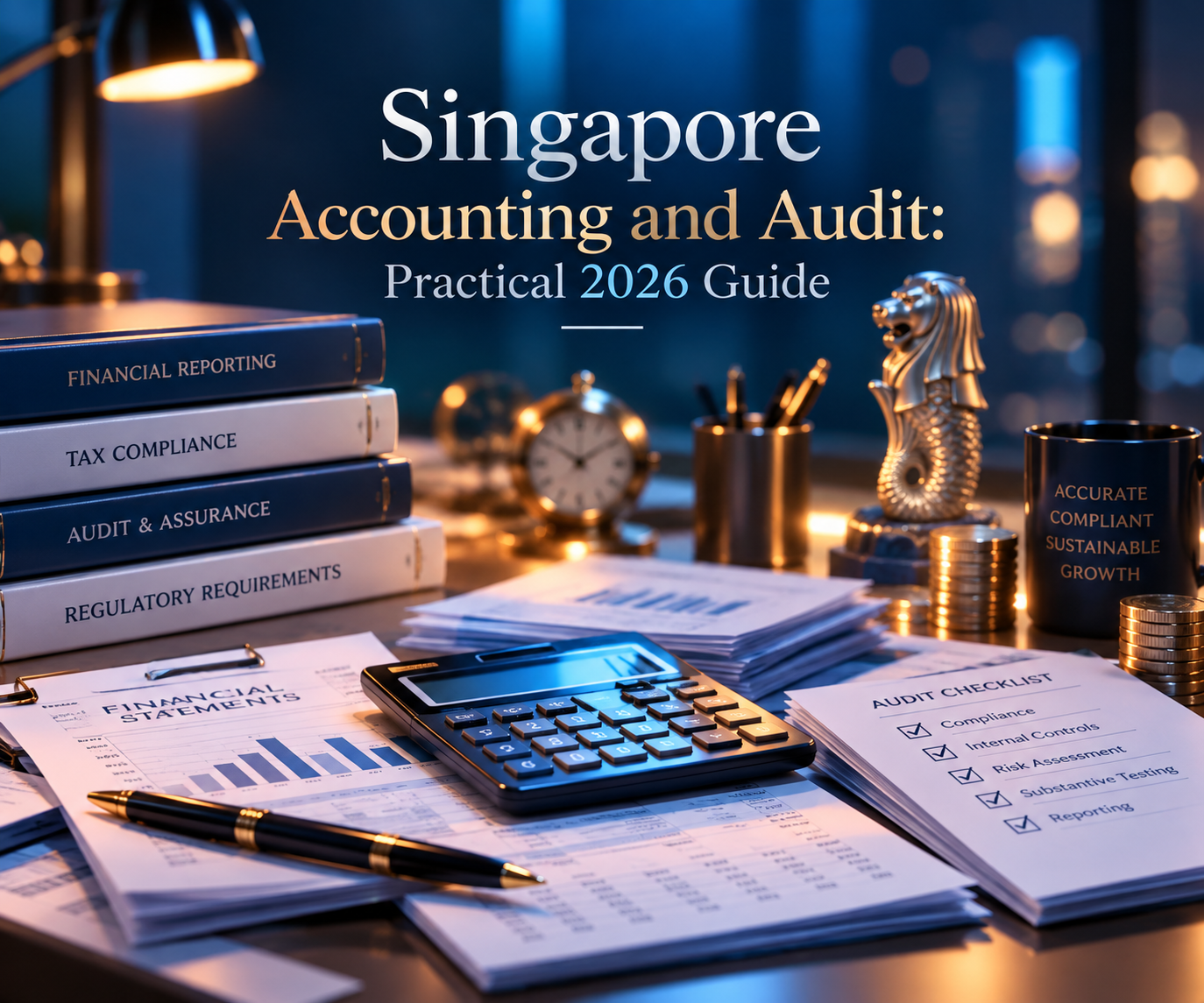
Singapore Accounting and Audit: A Practical 2026 Guide for Businesses
Singapore accounting and audit play an important role in helping businesses maintain accurate financial records, prepare financial statements, and meet applicable reporting responsibilities. In practice, Singapore accounting and auditing cover two connected but different functions: accounting organises financial information, while auditing independently examines financial statements when an audit is required.
Moreover, accurate accounting records support more than year-end reporting. They can also help businesses manage tax preparation, financial planning, cash flow, and audit readiness. Therefore, understanding how accounting and audit work together can make the financial reporting process more organised.
This practical 2026 guide explains Singapore accounting and audit from a business perspective. It covers accounting records, financial statements, audit preparation, XBRL filing, tax considerations, technology, and professional accounting support.
What Is Singapore Accounting and Audit?
Singapore accounting covers the process of recording, classifying, reconciling, and reporting financial transactions.
By contrast, auditing serves a different purpose. When a statutory audit is required, an independent auditor examines the company’s financial statements and supporting evidence before issuing an audit opinion.
Although these functions work closely together, they should not be treated as the same service. For example, accounting helps a company record sales, expenses, assets, liabilities, and other financial transactions. Meanwhile, Singapore audit and accounting processes connect those records with financial reporting and independent examination.
A typical financial reporting cycle looks like this:
Business transactions → Accounting records → Reconciliation → Financial statements → Audit → Final reporting
Therefore, businesses benefit from treating accounting as an ongoing process rather than a task that only happens at year-end.
For professional bookkeeping and financial statement support, businesses can also review uSafe’s Accounting, Bookkeeping and Preparing Financial Statements service.
Why Singapore Accounting Matters Before an Audit
An audit does not create a company’s accounting records. Instead, auditors examine information that has already been recorded and presented in the financial statements.
Consequently, incomplete accounting records can result in additional questions, reconciliations, supporting documents, or adjustments during the audit.
For this reason, strong accounting practices can make the audit process more organised. Throughout the year, businesses should ensure their accounting system can clearly track:
- Revenue
- Expenses
- Bank transactions
- Accounts receivable
- Accounts payable
- Payroll
- Fixed assets
- Loans
- Inventory
- Share capital
- Related-party transactions
- Intercompany balances
- Foreign currency transactions
Furthermore, regular accounting reviews give management an opportunity to identify unusual transactions before year-end.
As a result, unresolved accounting questions can be addressed earlier rather than being carried into the audit period. In turn, communication between the company and its auditor can become more efficient.
Does Every Singapore Company Need an Audit?
Not every Singapore company needs a statutory audit.
Under Singapore’s small company concept, a private company may qualify for audit exemption if it meets the applicable criteria. Generally, the company must meet at least two of three quantitative criteria for the relevant assessment period.
However, businesses should assess their own circumstances before assuming that an audit is or is not required.
At the same time, audit exemption does not remove accounting responsibilities.
In other words:
Audit exemption does not automatically mean accounting exemption.
A company may still need accounting records, financial statements, and statutory filings even when an audit is not required.
For businesses that need broader accounting and corporate support in Singapore, uSafe’s Singapore business services provide another relevant resource.
Singapore Financial Statements and Accounting Standards
Financial statements connect everyday accounting with formal financial reporting.
Moreover, Singapore accounting and audit work together through these financial statements because they provide the foundation for reporting, taxation, and audit procedures.
Depending on the applicable framework, financial statements may include:
- Statement of financial position
- Statement of profit or loss
- Statement of cash flows
- Statement of changes in equity
- Notes to the financial statements
However, presentation and disclosure requirements can vary depending on the applicable reporting framework.
Therefore, companies should determine the appropriate accounting framework before preparing annual financial statements.
What Accounting Records Should Singapore Businesses Maintain?
Reliable records form the foundation of Singapore accounting and auditing.
More importantly, businesses should be able to trace financial information from the original transaction to the accounting records and eventually to the financial statements.
Revenue and Sales Records
Revenue transactions should have appropriate supporting documentation.
For example, businesses may maintain:
- Customer invoices
- Sales agreements
- Credit notes
- Receipts
- Payment records
- Revenue reconciliation schedules
In addition, significant or unusual revenue transactions deserve additional review before year-end.
As a result, businesses can identify incorrect entries, timing issues, or unusual balances earlier.
Purchase and Expense Records
Expense records require similar attention.
Typical supporting documents include:
- Supplier invoices
- Receipts
- Contracts
- Payment records
- Expense claims
- Supporting correspondence
Furthermore, keeping these records organised throughout the year makes financial reporting more efficient.
Bank Reconciliation
Bank reconciliation is another important accounting control.
During each reporting period, businesses should compare accounting records with bank statements and investigate unexplained differences.
Instead of carrying unresolved balances forward, accounting teams should resolve them promptly. Consequently, year-end closing can become smoother.
Accounts Receivable
Customer balances also deserve regular attention.
For instance, a review can identify:
- Overdue invoices
- Long-outstanding balances
- Customer disputes
- Credit notes
- Potential bad debts
Therefore, management can respond more quickly when collection or accounting issues appear.
Accounts Payable
Supplier balances should be reviewed using a similar process.
For example, monthly reviews can help identify:
- Unpaid invoices
- Missing liabilities
- Duplicate entries
- Supplier disputes
- Unusual balances
At the same time, this review helps ensure expenses are recorded in the correct accounting period.
Preparing Financial Statements Before an Audit
Once bookkeeping and reconciliations are complete, the company can begin preparing financial statements.
However, effective Singapore audit and accounting preparation involves more than exporting reports from accounting software.
Management should review significant balances, adjustments, and supporting evidence. For example, the review may cover:
- Revenue recognition
- Depreciation
- Accruals
- Prepayments
- Provisions
- Impairment
- Foreign currency balances
- Related-party transactions
Therefore, a structured closing process creates a stronger foundation for financial reporting.
Practical Year-End Process
- First, complete bookkeeping.
- Next, reconcile key accounts.
- Then, review unusual movements.
- After that, record year-end adjustments.
- Furthermore, prepare supporting schedules.
- Finally, prepare and review the financial statements.
- As a last step, organise audit documents.
By following these steps, businesses can reduce unnecessary delays during the audit.
Businesses that need professional support with financial statement preparation can also refer to uSafe’s accounting and bookkeeping service.
What Happens During a Singapore Audit?
When a statutory audit is required, the auditor performs procedures to obtain sufficient appropriate evidence.
The exact procedures depend on the company’s activities, reporting framework, systems, and risks. Therefore, audit procedures can differ between businesses.
Understanding the Business
At the beginning of the engagement, the auditor reviews:
- Business activities
- Revenue model
- Accounting systems
- Internal controls
- Financing arrangements
- Significant transactions
Assessing Financial Reporting Risks
Next, the auditor considers where material misstatements could occur.
Consequently, audit work is based on assessed risk rather than checking every transaction equally.
Testing Transactions and Balances
Testing may cover:
- Revenue
- Expenses
- Bank balances
- Receivables
- Payables
- Fixed assets
- Payroll
- Inventory
Additionally, analytical procedures or confirmations may be used where appropriate.
Reviewing Supporting Documents
Auditors may request:
- Contracts
- Invoices
- Bank statements
- Payment records
- Agreements
- Board minutes
- Reconciliation schedules
Therefore, organised documentation remains an important part of Singapore accounting and audit preparation.
Evaluating the Financial Statements
Finally, the auditor evaluates the financial statements and completes the audit report based on the evidence obtained.
Singapore Accounting and Audit: Key Differences
Although accounting and auditing work together, their responsibilities remain different.
| Accounting | Audit |
|---|---|
| Records financial transactions | Examines financial statements |
| Maintains accounting records | Tests selected information |
| Reconciles accounts | Evaluates potential misstatements |
| Prepares financial statements | Provides an independent audit opinion |
| Supports management reporting | Provides assurance where applicable |
In short, accounting creates and organises financial information, while auditing independently examines that information.
Singapore Accounting and Audit Preparation Checklist
A structured checklist makes year-end preparation easier.
Accounting Checklist
- Record all transactions
- Reconcile bank accounts
- Review receivables
- Review payables
- Review payroll
- Review fixed assets
- Record necessary adjustments
Financial Statement Checklist
- Prepare the trial balance
- Review account movements
- Complete year-end adjustments
- Review accounting policies
- Prepare financial statements
- Review disclosures
Audit Preparation Checklist
- Organise supporting documents
- Prepare account schedules
- Review related-party transactions
- Explain unusual movements
- Prepare responses to likely audit questions
Overall, this checklist creates a clearer connection between bookkeeping, financial reporting, and Singapore accounting and auditing preparation.
XBRL and Singapore Financial Statement Filing
XBRL is another important part of Singapore financial reporting.
In particular, it provides a structured digital format for certain financial statement filings.
Companies required to file financial statements may need to submit them in XBRL format. Furthermore, businesses should follow the latest ACRA requirements rather than relying on older filing procedures.
Common XBRL Checks
- Figures match the financial statements
- Currency indicators are correct
- Rounding is consistent
- Required templates are completed
- Validation checks are passed
Moreover, XBRL preparation should become part of the wider Singapore audit and accounting workflow instead of being left until the last minute.
How Singapore Accounting Connects With Corporate Tax
Singapore accounting and tax reporting are closely connected. Nevertheless, accounting profit and taxable income are not necessarily the same.
For this reason, companies may need adjustments relating to:
- Capital allowances
- Depreciation
- Non-deductible expenses
- Provisions
- Other tax treatments
The accounting records therefore provide an important starting point for tax preparation.
Consequently, maintaining accurate records throughout the year can support both financial reporting and corporate tax preparation.
Businesses requiring accounting together with tax coordination can also explore USafe Singapore services.
Technology in Modern Singapore Accounting and Auditing
Technology is changing how businesses manage financial information.
For example, cloud accounting systems can help organise:
- Digital invoices
- Bank transactions
- Expense records
- Customer balances
- Supplier balances
- Financial reports
Furthermore, digital systems make supporting documents easier to retrieve.
As a result, accounting teams can spend less time searching for records during year-end reporting.
However, technology alone does not guarantee accurate financial information.
Instead, businesses still need appropriate accounting policies, reconciliations, reviews, and internal controls.
Therefore, combining technology with sound accounting practices can create a more organised financial workflow.
How to Prepare for an Audit Before Year-End
Audit readiness should not begin only when the auditor sends the first request.
Instead, businesses can incorporate preparation into their normal accounting routine.
First, complete bookkeeping regularly. Next, reconcile major accounts. Then, investigate unusual transactions.
After that, prepare financial statements and supporting schedules. Finally, organise documentation so requested information can be provided efficiently.
By following this sequence, businesses can strengthen their Singapore accounting and audit process long before formal audit work begins.
When Should Singapore Businesses Start Audit Preparation?
There is no need to wait until the official audit period.
In fact, Singapore accounting and auditing preparation can begin several months before year-end.
| Period | Recommended activity |
|---|---|
| Monthly | Complete bookkeeping |
| Quarterly | Review financial information |
| 2–3 months before year-end | Review major balances |
| After year-end | Complete closing adjustments |
| Before audit | Prepare financial statements |
| During audit | Respond to information requests |
| After audit | Review final reporting |
Ultimately, the timeline depends on the company’s size, reporting requirements, transaction volume, and financial year-end.
When Can Professional Accounting Support Help?
Some businesses manage accounting internally. Others choose external support because they have limited finance resources, multiple currencies, or regional operations.
For example, professional support may be useful when a company has:
- High transaction volumes
- Multiple entities
- Cross-border operations
- Complex accounting adjustments
- Tight reporting deadlines
Moreover, external support can connect bookkeeping with financial reporting, tax preparation, and Singapore audit and accounting readiness.
The goal is not simply to outsource bookkeeping. Instead, businesses can use professional support to create a more connected finance process.
How USafe Supports Singapore Accounting and Audit
For businesses needing professional finance support, USafe provides accounting and bookkeeping services designed around ongoing financial management.
Its accounting services can include:
- Bookkeeping
- Financial statement preparation
- Management reporting
- XBRL conversion
- Administrative accounting support
For businesses looking for support with Singapore accounting and audit, these services can help connect day-to-day accounting with year-end reporting.
Explore Related USafe Services
These internal resources give readers a natural next step after learning about Singapore accounting and audit.
Frequently Asked Questions About Singapore Accounting and Audit
What is the difference between accounting and audit in Singapore?
Accounting records and organises financial information, while auditing independently examines financial statements when an audit is required.
Does every Singapore company need an audit?
No. Some companies may qualify for audit exemption if they meet the applicable requirements.
However, businesses should assess their own circumstances before determining whether an audit is required.
Does audit exemption remove accounting responsibilities?
No. Audit exemption does not automatically remove the need to maintain accounting records, prepare financial statements, or meet applicable filing requirements.
What accounting standards are used in Singapore?
Singapore companies may apply the applicable Singapore Financial Reporting Standards, including SFRS(I), depending on their reporting requirements.
What documents are commonly requested during an audit?
Common documents include:
- Financial statements
- Trial balances
- Bank reconciliations
- Contracts
- Invoices
- Supporting schedules
- General ledger reports
Therefore, keeping documents organised throughout the year can make the audit process easier.
What is XBRL?
XBRL is a structured digital reporting format used for certain financial statement filings in Singapore.
Can accounting services be outsourced?
Yes. Businesses can outsource bookkeeping, financial reporting, and related accounting activities where appropriate.
Moreover, professional support can help connect Singapore accounting and auditing activities with year-end reporting.
Conclusion
Singapore accounting and audit form two important parts of a company’s financial reporting process.
First, accounting creates and organises reliable financial information. Next, financial reporting turns that information into structured financial statements. Where an audit is required, an independent auditor then examines those statements and supporting evidence.
For this reason, businesses can benefit from preparing throughout the year rather than waiting until the audit begins.
Moreover, accurate bookkeeping, regular reconciliations, organised documentation, and consistent reviews create a stronger foundation for Singapore accounting and auditing.
Finally, companies looking for additional support can explore USafe’s accounting and bookkeeping services or Singapore business services to connect bookkeeping, financial reporting, and year-end preparation.

 English
  Chinese