Do You Need a Statutory Audit in Singapore? A 2026 Decision Guide
For many business owners, one question comes up every financial year: Does my company actually need a statutory audit in Singapore?
The answer is not always straightforward.
Some Singapore private companies may qualify for audit exemption, while others are required to have their financial statements audited. The answer can also become more complicated when a company is part of a group, grows rapidly, or has changing financial results.
In 2026, this topic is particularly important because the Accounting and Corporate Regulatory Authority (ACRA) is reviewing Singapore’s audit exemption framework. However, the current exemption rules remain applicable unless and until any changes take effect.
This guide helps business owners understand the decision without starting with complicated audit terminology.
The First Question: Does Your Company Need an Audit?
Before choosing an audit firm or preparing audit documents, start with a simpler question:
Is your company required to have its financial statements audited?
For many Singapore private companies, the starting point is the small company audit exemption.
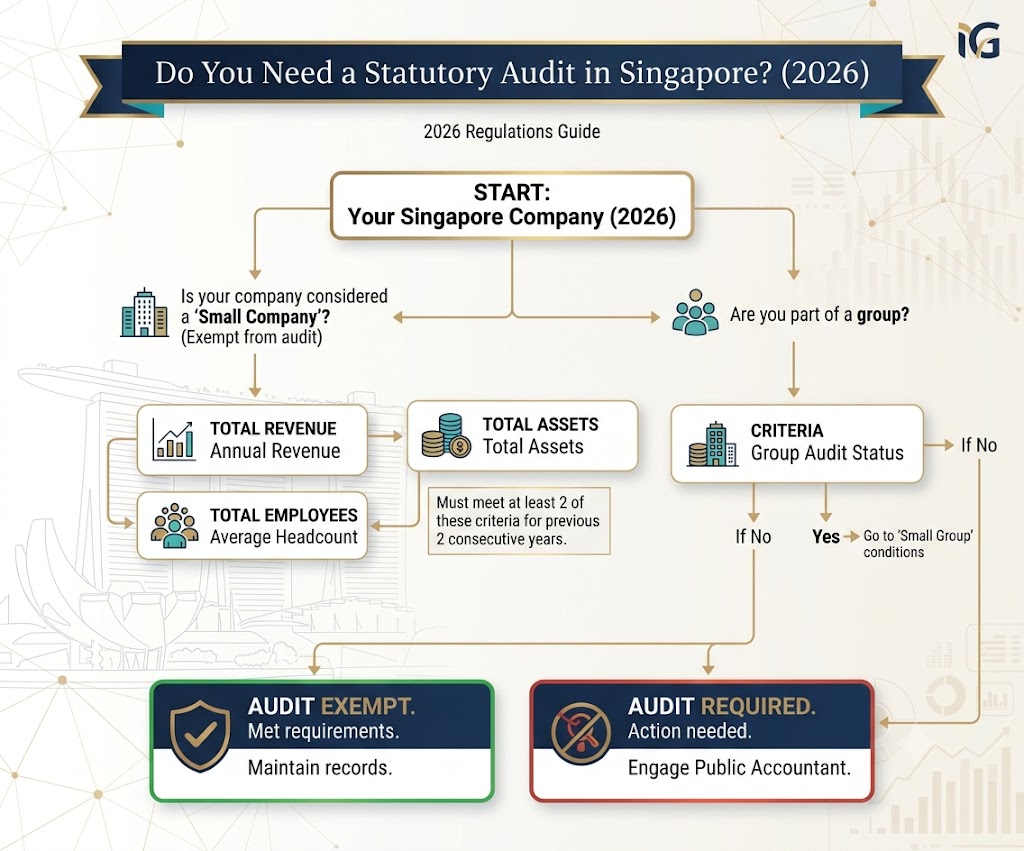
Under the current ACRA framework, a private company may qualify for audit exemption if it meets the required conditions and satisfies at least two out of three quantitative criteria for each of the immediate past two financial years:
- Annual revenue of S$10 million or less
- Total assets of S$10 million or less
- 50 employees or fewer
The company must also be a private company during the relevant financial year.
But there is an important detail:
Being small in one financial year does not automatically mean that the company is exempt.
The relevant historical financial years and the company’s status must be considered.
The 3-Number Test
One of the easiest ways to understand the current framework is to look at three numbers.
1. Revenue
Look at the company’s total annual revenue based on its financial statements prepared in accordance with the applicable accounting standards.
The current threshold is:
S$10 million or less
2. Total Assets
The second measure is total assets.
The current threshold is:
S$10 million or less
This can include assets such as:
- Cash and bank balances
- Trade receivables
- Property
- Plant and equipment
- Investments
- Inventory
- Right-of-use assets
- Other assets
3. Employees
The third measure is the number of employees.
The current threshold is:
50 employees or fewer
ACRA specifies that the employee criterion is based on the number of full-time employees at the end of the financial year.
You Do Not Need to Meet All Three
This is one of the most important points for business owners.
The company generally needs to meet at least two of the three criteria, not all three.
For example:
| Measure | Company A |
|---|---|
| Revenue | S$7 million |
| Total assets | S$14 million |
| Employees | 35 |
| Criteria met | 2 out of 3 |
Company A meets the revenue and employee criteria.
Therefore, assuming all other applicable requirements are satisfied, it may qualify for audit exemption.
Now consider another business:
| Measure | Company B |
|---|---|
| Revenue | S$12 million |
| Total assets | S$8 million |
| Employees | 40 |
| Criteria met | 2 out of 3 |
Although revenue exceeds S$10 million, the company meets the asset and employee criteria.
Again, the company may qualify for audit exemption if the other conditions are satisfied.
This is why simply looking at annual revenue is not enough.
Why the Two-Year Rule Matters
Another common misunderstanding is checking only the current year’s numbers.
Under the current framework, an existing private company generally needs to meet at least two of the three criteria for each of the immediate past two consecutive financial years.
This means a company that suddenly becomes smaller does not necessarily become audit-exempt immediately.
Example
Imagine:
Financial Year 2024
- Revenue: S$12 million
- Assets: S$9 million
- Employees: 45
Criteria met: 2
Financial Year 2025
- Revenue: S$8 million
- Assets: S$8 million
- Employees: 40
Criteria met: 3
If the other requirements are satisfied, the company may qualify under the applicable rules for the relevant financial year.
The important lesson is:
Do not decide audit exemption by looking at one year’s revenue alone.
What If Your Company Is Newly Incorporated?
New companies have a different consideration.
ACRA states that a newly incorporated company that is less than two years old can qualify for audit exemption if it meets the applicable criteria in the current financial year.
For example, a newly incorporated private company may have:
- Revenue: S$2 million
- Assets: S$4 million
- Employees: 12
The company meets two of the three quantitative criteria.
The company should still review its exact circumstances and applicable requirements before concluding that an audit is not required.
What If Your Company Is Part of a Group?
This is where the calculation becomes more important.
A Singapore company may not be able to assess audit exemption only by looking at its own financial statements if it belongs to a group.
ACRA states that a Singapore company or subsidiary seeking the exemption must qualify as a small company, and the entire group must also meet at least two of the three criteria on a consolidated basis for the relevant two consecutive financial years.
Example
Imagine a Singapore subsidiary has:
- Revenue: S$3 million
- Assets: S$4 million
- Employees: 20
At first glance, it looks like a small company.
However, its wider group has:
- Consolidated revenue: S$30 million
- Consolidated assets: S$25 million
- Employees: 120
The subsidiary should not assume that its own small size automatically gives it audit exemption.
Group status matters.
This is particularly relevant for:
- 外资企业
- Regional headquarters
- Singapore subsidiaries
- Investment groups
- Companies with multiple related entities
What If the Company Is Dormant?
Dormant companies can have different considerations from active businesses.
A company that has stopped trading should not simply assume that there are no remaining compliance requirements.
Its exact status, transactions and obligations should be reviewed before deciding that an audit is unnecessary.
The key point is:
Inactive does not automatically mean “no compliance.”
A company may still have corporate filing, financial reporting, tax and other obligations even when its business activity is limited.
Audit Exemption Does Not Mean Compliance Exemption
This is perhaps the biggest misconception surrounding audit exemption.
If your company qualifies for audit exemption, it does not mean:
- You can stop keeping accounting records
- You do not need financial statements
- You do not need to consider accounting standards
- You can ignore ACRA filing requirements
- You can ignore tax obligations
Audit exemption is specifically about the requirement for an audit.
It does not remove every other responsibility of running a Singapore company.
This distinction is important because some businesses assume:
“No audit means no financial statements.”
That is not correct.
Businesses should continue to maintain appropriate accounting records and comply with the applicable financial reporting and filing requirements. ACRA’s audit exemption framework specifically distinguishes audit exemption from other company obligations.
Four Real-World Situations
Instead of asking whether every company needs an audit, it is more useful to consider different business situations.
Situation 1: Small Local Business
A Singapore private company has:
- Revenue: S$4 million
- Assets: S$5 million
- Employees: 25
It may satisfy two or more of the current small-company criteria.
The business should then check its financial history and other applicable conditions.
For this type of company, the first question may be whether an audit exemption applies.
Situation 2: Fast-Growing Company
Consider a company that grew rapidly:
2024
Revenue: S$6 million
2025
Revenue: S$9 million
2026
Revenue: S$13 million
The company should not wait until the end of the year to think about audit requirements.
Rapid growth can change the company’s compliance position.
A company approaching the current thresholds should consider its likely financial position early and discuss the implications with its accountant or auditor.
Situation 3: Singapore Subsidiary of a Foreign Group
A Singapore subsidiary may have only S$3 million in local revenue.
However, its global group may be substantially larger.
In this situation, the company needs to consider the group-level criteria, not only its own Singapore figures.
This is one of the situations where professional advice can prevent an incorrect assumption about audit exemption.
Situation 4: Small Company Seeking Bank Financing
A company may technically qualify for audit exemption but still decide that an audit is useful.
Why?
Because the business may be:
- Applying for financing
- Seeking new investors
- Preparing for a major transaction
- Planning an acquisition
- Preparing for a future sale
- Working with international shareholders
In these situations, independently audited financial statements may provide additional confidence to stakeholders.
An audit can therefore be commercially useful even when it is not legally mandatory.
When an Audit Can Still Make Sense
The legal question is:
“Do we have to audit?”
The business question is:
“Would an audit help us?”
These are two different questions.
A company may voluntarily choose to obtain an audit because it wants stronger financial credibility.
Banks and Financing
Lenders may want reliable financial information when evaluating financing applications.
Investors
Investors may be more comfortable with independently reviewed financial information.
Shareholders
An audit can provide additional confidence where shareholders are not involved in the company’s day-to-day operations.
Business Sale
If the owner plans to sell the company, historical financial information may become an important part of the transaction process.
Internal Controls
The audit process can also bring attention to weaknesses in financial processes and documentation.
Future Growth
A company that is currently small may soon become large enough to require an audit.
Building good accounting processes early can make that transition easier.
What Does a Statutory Audit Actually Look At?
Once a company determines that an audit is required, the next question is what happens during the audit.
A statutory audit is an independent examination of financial statements.
Singapore auditors work within the Singapore Standards on Auditing (SSAs). ISCA describes SSAs as standards written in the context of audits of financial statements by an independent auditor.
Depending on the company, auditors may examine areas such as:
- Revenue
- Expenses
- Cash
- Receivables
- Payables
- Inventory
- Fixed assets
- Leases
- Loans
- Investments
- Related-party transactions
- Tax balances
- Financial estimates
- Going concern matters
The audit approach is not identical for every company.
A business with simple transactions may have a very different risk profile from a multinational group with complex financial instruments.
Why Good Accounting Records Matter
Many audit delays are not caused by the auditor.
They are caused by incomplete information.
For example, an auditor may request:
Bank reconciliation
but management has not completed the reconciliation.
Or the auditor may ask for:
Accounts receivable confirmation
but the customer records are incomplete.
Or the auditor may identify:
A significant lease
but the company has not provided the lease agreement.
These situations can slow down the engagement.
Good accounting records therefore benefit both the company and the audit process.
What Should a Company Prepare Before an Audit?
A practical preparation file can include:
Corporate Information
- Company profile
- Constitution
- Shareholder information
- Director information
- Board resolutions
- Major contracts
Accounting Information
- Trial balance
- General ledger
- Bank reconciliations
- Accounts receivable listing
- Accounts payable listing
- Fixed asset register
- Inventory reports
Supporting Documents
- Sales invoices
- Purchase invoices
- Bank statements
- Loan agreements
- Lease agreements
- Investment documents
- Payroll information
Additional Information
- Related-party transactions
- Significant estimates
- Tax information
- Major legal matters
- Subsequent events
- Important contracts
Preparing these items early can make communication between management, accountants and auditors much more efficient.
What Happens If a Company Is Not Audit-Exempt?
If a company does not qualify for an applicable audit exemption, it should plan for the statutory audit as part of its annual financial reporting process.
The process normally involves:
Accounting records → Financial statements → Audit planning → Audit procedures → Adjustments → Auditor’s report
The exact procedures depend on the company.
The auditor may assess risks, examine supporting evidence, perform analytical procedures, test selected transactions and consider whether the financial statements are materially misstated.
ISCA’s SSA framework includes standards covering areas such as audit planning, risk assessment, audit evidence, sampling, related parties and going concern.
2026: Why Businesses Should Watch the Audit Exemption Review
There is an important development for Singapore businesses in 2026.
于 26 February 2026, ACRA announced a review of Singapore’s audit exemption framework.
The purpose of the review is to consider ways to reduce compliance costs for small companies while maintaining appropriate safeguards.
ACRA’s announcement confirms that the current framework uses:
- S$10 million revenue
- S$10 million assets
- 50 employees
with the requirement to meet at least two of the three criteria for each of the two immediately preceding financial years.
However, businesses should distinguish between:
Current law
和
Potential future changes.
A review does not automatically change the existing requirements.
Therefore, companies should continue to apply the current rules unless and until ACRA announces that new requirements have taken effect.
What About Singapore Auditing Standards in 2026?
Another important development is the continued update of Singapore’s auditing standards.
ISCA’s current standards page lists revised SSAs with various effective dates, including a number of revised standards applying to periods beginning on or after 15 December 2026.
This means companies and audit professionals should pay attention not only to whether an audit is required, but also to the applicable standards and effective dates for the relevant reporting period.
For businesses, the practical lesson is simple:
Do not rely on an old audit checklist indefinitely.
Regulatory and professional requirements can change.
A Simple Audit Decision Checklist
Before deciding whether your company needs a statutory audit, ask:
- Is the company a private company?
- What was the annual revenue for the relevant financial years?
- What were total assets for those years?
- How many full-time employees did the company have?
- Did the company meet at least two of the three current criteria?
- Has it done so for the required two consecutive financial years?
- Is the company part of a group?
- If so, does the entire group meet the applicable criteria?
- Is the company newly incorporated?
- Is the company dormant?
- Are there investors or lenders who may request audited financial statements?
- Is the company planning a major transaction?
- Is the business likely to exceed the current thresholds soon?
- Have there been any changes in the applicable regulatory framework?
If several of these questions are unclear, it is better to obtain professional advice rather than simply assume that an audit is unnecessary.
Audit Exemption Is a Business Decision Too
The most useful way to think about audit exemption is not simply:
“Can we save the audit fee?”
Instead, consider three questions:
1. Is an audit legally required?
This is the compliance question.
2. If not, would an audit still provide value?
This is the business question.
3. Is the company likely to need an audit in the near future?
This is the planning question.
A company that considers all three can make a much better decision.
Why Businesses Should Review Their Position Early
Waiting until the financial year has ended can create unnecessary pressure.
For example, if a growing company is approaching the current exemption thresholds, management should understand the potential impact before year-end.
Early planning can help with:
- Accounting adjustments
- Financial reporting
- Documentation
- Audit appointment
- Budgeting
- Internal controls
- Reporting deadlines
This is especially important for businesses experiencing rapid growth or changes in ownership.
How USafe Can Help
Understanding whether your company requires a statutory audit is only one part of financial compliance.
Businesses also need accurate accounting records, appropriate financial reporting and ongoing corporate compliance.
uSafe can support businesses with accounting, audit and compliance-related needs in Singapore.
The objective is not simply to complete an annual compliance task.
It is to help businesses develop a more reliable financial reporting process so that management can make decisions based on better information.
For companies approaching the audit exemption thresholds, entering a new growth stage or dealing with more complex financial reporting, early professional support can also make the transition more manageable.
Final Thoughts
Do you need a statutory audit in Singapore?
The answer depends on your company’s structure, financial position, history and group circumstances.
For many private companies, the current small-company audit exemption framework provides a way to qualify for audit exemption when the applicable conditions are met. The current framework looks at three main measures: revenue, assets and employees, with at least two criteria generally required for the relevant two consecutive financial years.
But audit exemption does not mean that a company can ignore financial reporting, accounting records or other compliance responsibilities.
There is also an important reason to monitor developments in 2026: ACRA is reviewing Singapore’s audit exemption framework.
For business owners, the best approach is therefore not to ask only whether an audit is mandatory.
Ask instead:
“What does my company need today, and what will it need as the business grows?”
That approach can help turn statutory compliance from a year-end obligation into a better long-term financial management strategy.
Frequently Asked Questions
1. Is statutory audit mandatory in Singapore?
Not for every company. Certain private companies may qualify for audit exemption if they meet the applicable conditions under the current framework.
2. What are the current small-company audit exemption thresholds?
The current framework uses three criteria: annual revenue of S$10 million or less, total assets of S$10 million or less, and 50 employees or fewer. A qualifying private company generally needs to meet at least two of the three criteria for each of the relevant two consecutive financial years.
3. Does audit exemption mean my company does not need financial statements?
No. Audit exemption relates to the audit requirement. Other financial reporting, accounting and filing obligations may still apply.
4. Can a subsidiary qualify for audit exemption?
Potentially, but group conditions need to be considered. A Singapore company in a group generally needs to satisfy the applicable small-company criteria itself, while the entire group must also meet the relevant small-group criteria.
5. Is ACRA changing the audit exemption rules in 2026?
ACRA announced on 26 February 2026 that it is reviewing the audit exemption framework. The review does not by itself mean that the current thresholds have already changed.
6. What standards are used for audits in Singapore?
Singapore financial statement audits are conducted under the applicable Singapore Standards on Auditing (SSAs). ISCA maintains the current SSA framework and publishes effective dates for revised standards.
7. Should a company voluntarily have an audit even if exempt?
It can be commercially useful in some circumstances, such as financing, investment, shareholder reporting, major transactions or preparing for future growth. The decision should depend on the company’s specific circumstances.
References / Sources
- Accounting and Corporate Regulatory Authority (ACRA) — Audit Exemptions: Small Company Concept. ACRA – Audit Exemptions
- Accounting and Corporate Regulatory Authority (ACRA) — Reducing Compliance Costs for Small Companies: Review of Audit Exemption Framework, 26 February 2026. ACRA – 2026 Audit Exemption Review
- Institute of Singapore Chartered Accountants (ISCA) — Singapore Standards on Auditing (SSAs). ISCA – Singapore Standards on Auditing
- Institute of Singapore Chartered Accountants (ISCA) — Standards & Guidance. ISCA – Standards & Guidance


 Chinese
  English