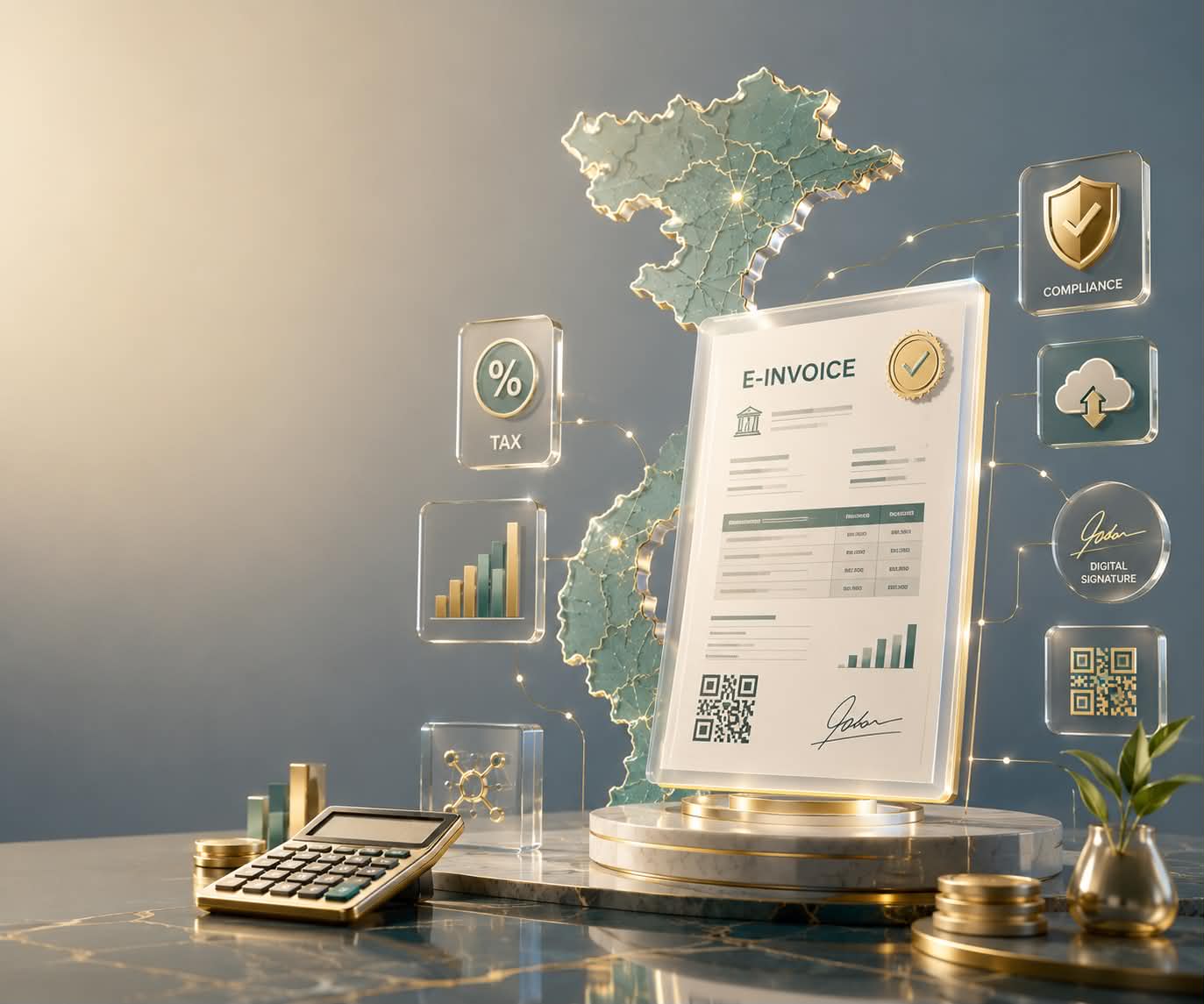
Vietnam E-Invoice Regulations 2026: Complete Business Guide
Vietnam is moving further toward digital tax administration. Therefore, businesses operating in the country need to understand the latest electronic invoicing requirements and adjust their accounting processes accordingly.
The Vietnam e-invoice regulations 2026 framework is particularly important because new rules under Decree 254/2026/ND-CP and Circular 91/2026/TT-BTC took effect on 1 July 2026. These regulations provide detailed rules for electronic invoices and electronic documents under Vietnam’s updated tax administration framework.
For companies, however, compliance is not simply about generating an electronic invoice. Instead, businesses should connect invoicing with accounting, tax reporting, data management and internal controls.
This guide explains the key points businesses should understand in 2026.
What Are Vietnam E-Invoice Regulations?
Vietnam e-invoice regulations establish the rules that businesses must follow when creating, issuing, managing and using electronic invoices.
An electronic invoice records the sale of goods or provision of services in digital form. Depending on the applicable requirements, businesses may use invoices involving tax authority codes, invoices without tax authority codes, or other permitted electronic invoice solutions.
Furthermore, the regulations establish requirements concerning invoice information, issuance procedures, electronic data and related tax administration processes.
As a result, companies should treat their e-invoice system as part of their wider financial management structure.
What Changed Under Vietnam E-Invoice Regulations 2026?
A major development in 2026 is Decree 254/2026/ND-CP.
The Government issued the decree on 30 June 2026, and it became effective on 1 July 2026. The decree provides detailed provisions for implementing the Law on Tax Administration concerning electronic invoices and electronic documents.
At the same time, the Ministry of Finance issued Circular 91/2026/TT-BTC. This circular also took effect on 1 July 2026 and provides additional rules related to the Law on Tax Administration and Decree 254/2026/ND-CP.
Therefore, businesses should review their existing invoicing procedures rather than assume that older internal processes remain sufficient.
Why Does This Matter?
The updated framework strengthens the connection between electronic invoicing and tax administration.
Consequently, inaccurate invoice information can create problems beyond the invoice itself. It may also affect accounting records, VAT reporting, customer reconciliation and tax compliance.
For this reason, businesses should review the entire transaction cycle.
Sale → E-invoice → Accounting entry → Tax reporting → Financial records
When each stage matches, the company has stronger financial controls.
Who Needs to Pay Attention to E-Invoice Compliance?
Most businesses that sell goods or provide services in Vietnam should understand their electronic invoicing obligations.
This includes:
- Vietnamese companies
- Foreign-invested enterprises
- Branches and business establishments
- Companies providing professional services
- Retail businesses
- E-commerce businesses
- Companies selling goods domestically
- Businesses with recurring B2B transactions
However, the exact requirements can differ depending on the business model and transaction.
Therefore, companies should assess their specific circumstances before choosing an invoicing process.
When Must a Business Issue an Electronic Invoice?
As a general principle, when a business sells goods or provides services, the seller must issue an electronic invoice to the buyer, except where the law provides an applicable exception.
Decree 254/2026/ND-CP sets out this principle and also covers transactions involving promotional goods, advertising goods, samples, gifts, exchanges, employee remuneration and internal consumption in relevant circumstances.
Consequently, companies should establish clear procedures for determining when an invoice must be created.
This is particularly important for businesses with large transaction volumes.
Example
Suppose a company sells 500 products during a business day.
The accounting team records the sales. Meanwhile, the invoicing system generates electronic invoices.
If the sales report shows VND 1 billion but the invoice system records VND 950 million, the company has a reconciliation problem.
Therefore, businesses should perform regular checks between sales data and invoice data.
What Information Must an E-Invoice Contain?
One of the most important areas under the Vietnam e-invoice regulations 2026 framework is invoice content.
Decree 254/2026/ND-CP specifies information that electronic invoices must contain. This includes invoice identification information, seller information, buyer information and transaction details.
Depending on the transaction, relevant information can include:
- Invoice name
- Invoice symbol
- Invoice template symbol
- Invoice number
- Seller’s name
- Seller’s address
- Seller’s tax identification number
- Buyer’s information
- Description of goods or services
- Unit of measurement
- Quantity
- Unit price
- Amount before VAT
- VAT rate
- VAT amount
- Total payment amount
- Invoice date
- Other required information
However, not every transaction has exactly the same data requirements.
Therefore, companies should configure their accounting and invoicing systems according to their actual business activities.
How Should Businesses Manage E-Invoice Data?
Electronic invoicing creates valuable financial data.
However, that data only becomes useful when the company manages it properly.
Businesses should maintain consistency between:
Customer data
Sales data
Invoice data
Accounting data
Tax data
This approach reduces duplicate entries and makes financial reconciliation easier.
Moreover, companies can use accurate invoice data to improve cash-flow monitoring and management reporting.
Common E-Invoice Mistakes in Vietnam
Even when a business uses an automated invoicing platform, errors can still occur.
1. Incorrect Tax Identification Information
Incorrect seller or buyer information can create reconciliation difficulties.
Therefore, companies should maintain accurate master data and review customer information regularly.
2. Incorrect Product or Service Details
The invoice should accurately describe the underlying transaction.
For example, companies should avoid using vague descriptions when more specific information is required.
3. Incorrect VAT Information
Businesses should apply the appropriate tax treatment to each transaction.
Furthermore, the accounting team should reconcile VAT amounts between invoices and tax returns.
4. Delayed Invoice Processing
Businesses should understand when the law requires invoice issuance.
A delay can create compliance risks and make month-end reconciliation more difficult.
5. Poor Accounting Reconciliation
An invoice system cannot replace proper accounting controls.
Instead, businesses should compare invoices with sales reports, bank records and accounting entries.
6. Using Outdated Procedures
Vietnam’s tax environment continues to develop.
Therefore, companies should periodically review their accounting and invoicing procedures.
How Foreign Companies Can Prepare for 2026
Foreign-invested companies often face additional complexity because their accounting processes may connect Vietnam operations with regional or international headquarters.
For example, a group may use one ERP system across Singapore, Vietnam and Malaysia.
However, each country has its own tax and invoicing requirements.
Therefore, the Vietnam entity should maintain procedures that comply with local regulations while still supporting group-level reporting.
A practical compliance framework should cover:
- Tax registration
- E-invoice registration
- Accounting software
- Customer information
- Invoice issuance
- VAT treatment
- Revenue reconciliation
- Tax reporting
- Document retention
- Management review
This structure can help management identify problems earlier.
For companies expanding into Vietnam, professional Vietnam accounting services can also help establish appropriate processes from the beginning.
E-Invoices and Business Financial Control
Electronic invoices are not only a tax compliance tool.
They can also improve business management.
When invoice data connects with accounting records, management can obtain better visibility over:
- Revenue
- Accounts receivable
- Customer balances
- VAT obligations
- Sales performance
- Cash-flow planning
- Financial reporting
Furthermore, consistent invoice data can reduce manual work.
As a result, a properly designed invoicing process can support both compliance and operational efficiency.
How to Improve E-Invoice Compliance
Businesses can take several practical steps.
Review Current Procedures
First, identify how invoices currently move from the sales team to accounting.
Then, determine whether the process matches current regulatory requirements.
Check Accounting Software
Next, review whether the accounting and invoicing systems can support the company’s current requirements.
Establish Approval Controls
Companies should define who can create, review and approve invoices.
This is especially important for businesses with multiple branches or departments.
Reconcile Regularly
Businesses should compare invoice data with accounting records and sales reports.
Monthly reconciliation can help identify discrepancies before they become larger problems.
Monitor Regulatory Updates
Finally, companies should monitor changes to Vietnam tax and accounting regulations.
The rules can evolve, so an annual review may not always be sufficient.
Vietnam E-Invoice Compliance Checklist 2026
Before finalizing their e-invoice procedures, businesses should ask the following questions:
- Is our business using the appropriate electronic invoice method?
- Are our tax registration details accurate?
- Is our customer information up to date?
- Does each invoice contain the required information?
- Does the invoice match the underlying transaction?
- Are VAT amounts correctly recorded?
- Do invoice records match accounting records?
- Do sales reports reconcile with invoice data?
- Can we retrieve electronic records when required?
- Have we reviewed our procedures after the 2026 regulatory changes?
If the answer to any question is unclear, the company should investigate the issue.
How uSafe Can Help Businesses in Vietnam
Vietnamese and foreign-invested businesses often need reliable accounting and tax support to manage changing compliance requirements.
uSafe can support companies with accounting, tax, bookkeeping, financial reporting and compliance-related services.
For example, businesses can combine Vietnam accounting services with internal financial controls to improve the accuracy of their accounting records.
Companies can also review their broader Vietnam tax services requirements when electronic invoicing affects VAT reporting and other tax processes.
For businesses entering the Vietnamese market, Vietnam company registration can provide a starting point for establishing the correct corporate and tax structure.
Meanwhile, ongoing Vietnam corporate compliance can help management maintain appropriate regulatory procedures after incorporation.
The exact support required depends on the company’s size, industry, transaction volume and ownership structure.
Frequently Asked Questions
1. What are Vietnam e-invoice regulations 2026?
Vietnam e-invoice regulations 2026 are the rules governing electronic invoice creation, issuance, management and use under Vietnam’s updated tax administration framework.
Decree 254/2026/ND-CP and Circular 91/2026/TT-BTC are important regulatory documents effective from 1 July 2026.
2. When did the new Vietnam e-invoice rules take effect?
Decree 254/2026/ND-CP and Circular 91/2026/TT-BTC both took effect on 1 July 2026.
3. What information should an electronic invoice contain?
Depending on the transaction, an electronic invoice generally includes invoice identification, seller information, buyer information and details about the goods or services.
Businesses should check the specific requirements applicable to their transaction.
4. Do foreign-invested companies need to follow Vietnam e-invoice rules?
Yes. Foreign-invested companies conducting taxable business activities in Vietnam need to assess and comply with applicable Vietnamese tax and electronic invoicing requirements.
5. Can accounting software help with e-invoice compliance?
Yes. Appropriate accounting and invoicing software can automate invoice generation, data management and reconciliation.
Nevertheless, software does not remove the company’s responsibility to maintain accurate accounting and tax records.
6. Why should businesses review their e-invoice procedures in 2026?
Businesses should review their procedures because new rules under Decree 254/2026/ND-CP and Circular 91/2026/TT-BTC became effective on 1 July 2026.
Conclusion
The Vietnam e-invoice regulations 2026 framework represents another important step in Vietnam’s digital tax administration.
For businesses, the key challenge is not simply issuing electronic invoices. Instead, companies need to create a consistent process that connects sales, invoicing, accounting and tax reporting.
Furthermore, businesses should regularly review their procedures as regulations develop.
For foreign-invested companies, this becomes even more important because Vietnam accounting and tax requirements may need to integrate with regional or international financial systems.
Ultimately, strong e-invoice controls can provide more than regulatory compliance. They can also improve financial accuracy, reduce reconciliation problems and give management better visibility over business performance.
For this reason, businesses should treat electronic invoicing as an important part of their overall accounting and compliance strategy in 2026.
Official Sources
- Government of Vietnam — Decree 254/2026/ND-CP.
- Government Gazette — Decree 254/2026/ND-CP.
- Government of Vietnam — Circular 91/2026/TT-BTC.
- Government of Vietnam — Guidance on electronic invoice contents.


 Chinese
  English