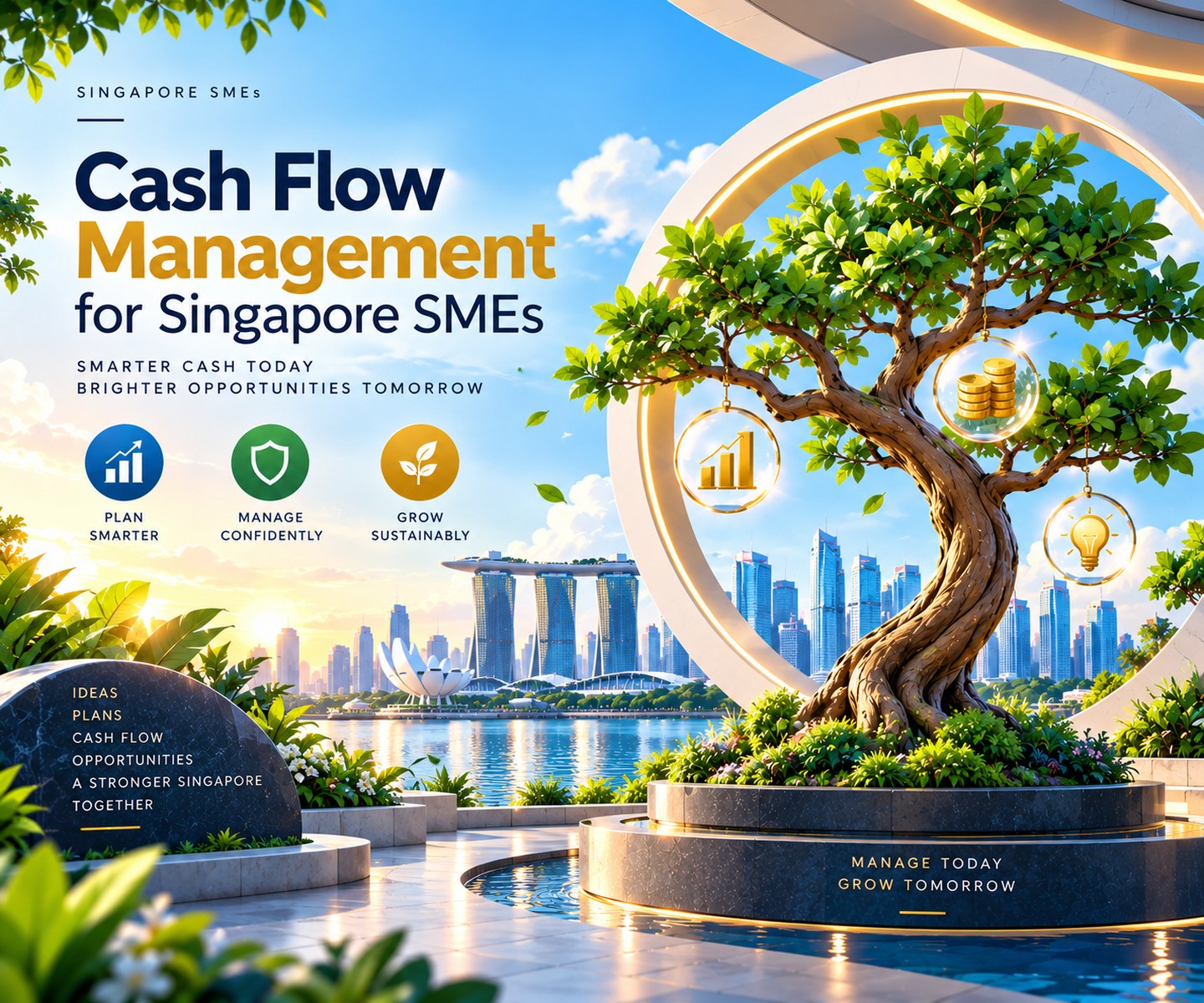
Cash Flow Management Singapore: A Practical Guide for SMEs
Cash Flow Management Singapore is essential for SMEs that want to maintain sufficient cash for daily operations, supplier payments, salaries, taxes and business growth. Even a profitable company can experience financial pressure when customers pay late or major expenses become due before expected income arrives.
Effective cash flow management helps Singapore SMEs understand when money enters the business, when it leaves and how much cash should remain available for future obligations.
What Is Cash Flow Management?
Cash flow management is the process of monitoring and controlling the money moving into and out of a business.
It normally involves three areas:
- Cash inflows from customers, financing and other sources
- Cash outflows for suppliers, salaries, rent, taxes and operating costs
- Cash reserves available for future obligations and unexpected expenses
Profit and cash flow are not the same. A company can record strong sales while still waiting weeks or months for customers to pay.
For this reason, Cash Flow Management Singapore practices should focus on both profitability and payment timing.
Enterprise Singapore encourages SMEs to monitor cash flows, expenses, revenues, receivables and payables regularly. It also highlights working capital as an important part of maintaining a healthy business. Enterprise Singapore – Financial Position and Working Capital
Why Cash Flow Management Singapore Matters for SMEs
Cash flow affects almost every part of daily business operations.
A healthy cash position can help an SME:
- Pay employees on time
- Pay suppliers according to agreed terms
- Meet tax obligations
- Fund inventory purchases
- Handle unexpected expenses
- Invest in business growth
- Reduce reliance on emergency borrowing
- Respond to new opportunities
However, growing revenue does not always mean improving cash flow.
For example, a company may win a large contract but need to pay employees, suppliers and production costs before receiving payment from the customer.
Consequently, businesses should monitor the timing of cash inflows as closely as they monitor sales.
Cash Flow vs Profit: What Is the Difference?
Profit measures revenue and expenses over an accounting period. Cash flow, on the other hand, tracks the actual movement of money into and out of the business.
Consider a simple example.
A Singapore SME sells S$50,000 of services in January. The customer has 60-day payment terms. Therefore, the business may recognise the sale in January but receive the cash in March.
During February, the company may still need to pay:
- Salaries
- Office expenses
- Software subscriptions
- Suppliers
- GST obligations, where applicable
- Other operating costs
As a result, a profitable company can still experience temporary cash pressure.
This difference makes cash flow forecasting an important part of Cash Flow Management Singapore strategies.
Cash Flow Management Singapore: How to Prepare a Forecast
A cash flow forecast estimates the amount of cash a company expects to receive and spend during a future period.
For many SMEs, a rolling 13-week forecast can provide a useful short-term view of upcoming cash requirements.
A basic forecast can include:
| Category | Examples |
|---|---|
| Opening cash | Bank balance at the beginning of the period |
| Customer collections | Expected customer payments |
| Other inflows | Financing, refunds or other receipts |
| 工资单 | Salaries and related costs |
| Suppliers | Inventory and service payments |
| Rent | Office or premises costs |
| Taxes | GST, corporate tax and other obligations |
| Financing | Loan repayments and interest |
| Other expenses | Insurance, software and operating costs |
| Closing cash | Expected cash balance |
The basic calculation is:
Opening cash + cash inflows − cash outflows = closing cash
Update the forecast regularly. An outdated forecast can provide a misleading picture of the company’s financial position.
Improve Customer Payment Collection
Late customer payments can create significant working capital pressure.
Singapore SMEs can improve collections by establishing clear payment terms before delivering goods or services.
Practical measures include:
- State payment terms clearly on invoices
- Set specific invoice due dates
- Issue invoices promptly
- Send payment reminders before the due date
- Follow up quickly on overdue invoices
- Review customers with repeated late payments
- Request deposits for suitable projects
- Use milestone billing for longer engagements
For example, a professional services company could request a 30% deposit before beginning a large project and invoice the remaining amount according to agreed milestones.
This approach can reduce the amount of working capital the company needs to fund itself.
Review Customer Credit Terms
Payment terms directly affect how quickly sales become cash.
If customers consistently receive 60- or 90-day payment terms, the company may need more working capital than a business that collects within 30 days.
Before offering extended credit, consider:
- Customer payment history
- Contract value
- Credit risk
- Project duration
- Supplier payment terms
- Available cash reserves
Longer payment terms may support sales. However, they can also increase pressure on working capital.
Therefore, SMEs should balance customer expectations with their ability to fund operations.
Manage Accounts Receivable
Accounts receivable represents money owed by customers.
A growing receivables balance can become a problem when collections do not keep pace with sales.
Businesses should regularly review:
- Total outstanding invoices
- Current invoices
- Overdue invoices
- Average collection period
- Largest outstanding customers
- Long-overdue balances
An accounts receivable ageing report can make these issues easier to identify.
| Age | Example Amount |
|---|---|
| Current | S$80,000 |
| 1–30 days overdue | S$25,000 |
| 31–60 days overdue | S$12,000 |
| Over 60 days overdue | S$8,000 |
The purpose is not simply to track unpaid invoices. Instead, the report helps management identify where cash may be delayed.
Manage Accounts Payable
Cash flow management also involves controlling when money leaves the business.
SMEs should review supplier payment terms and avoid paying substantially earlier than required unless there is a clear commercial benefit.
At the same time, businesses should honour agreed payment terms and maintain good supplier relationships.
A practical approach includes:
- Negotiating suitable payment terms
- Scheduling payments around agreed due dates
- Reviewing supplier contracts
- Avoiding unnecessary advance payments
- Consolidating supplier invoices where appropriate
- Communicating with suppliers when circumstances change
The objective is to manage payment timing responsibly rather than simply delay payments.
Control Operating Expenses
Recurring expenses can gradually reduce available cash.
Review costs such as:
- Software subscriptions
- Advertising
- Professional fees
- Office rent
- Telecommunications
- Insurance
- Travel
- Outsourced services
For each major expense, ask whether it remains necessary and whether it supports current business objectives.
However, cost reduction should be strategic. Cutting essential services may create operational problems or reduce revenue in the future.
Build an Appropriate Cash Reserve
A cash reserve can provide protection when business conditions change.
The appropriate reserve depends on factors such as:
- Monthly operating costs
- Revenue stability
- Customer concentration
- Industry conditions
- Debt obligations
- Seasonal patterns
- Access to financing
There is no single reserve amount that applies to every Singapore SME.
Instead, management should determine how much cash is required to cover essential obligations during periods of weaker collections or unexpected expenses.
Plan for GST and Tax Payments
Tax obligations should form part of the cash flow forecast.
For GST-registered businesses, GST payments can affect short-term cash requirements. IRAS states that GST due must generally be paid within one month after the end of the accounting period. IRAS – Responsibilities of a GST-Registered Business
Eligible small businesses may also consider whether the GST Cash Accounting Scheme applies to them. IRAS states that qualifying businesses with taxable supplies not exceeding S$1 million may use the scheme, subject to the applicable conditions. IRAS – Cash Accounting Scheme
Corporate income tax should also be included in financial planning. IRAS generally requires companies to pay corporate income tax within one month from the date of the Notice of Assessment. IRAS – Corporate Income Tax Filing Season
Planning these payments in advance can reduce unexpected pressure on working capital.
Monitor Working Capital
Working capital is closely connected to cash flow.
A simplified calculation is:
Current assets − current liabilities = working capital
Important areas include:
- Cash
- Accounts receivable
- Inventory
- Accounts payable
- Short-term liabilities
Enterprise Singapore highlights collections, credit facilities and inventory management as important elements of working capital management. Enterprise Singapore – Financial Position and Working Capital
For inventory-based businesses, excessive stock can tie up cash that could otherwise support operations.
Therefore, companies should regularly compare inventory levels with actual and expected demand.
Track Cash Flow KPIs
SMEs do not need dozens of financial indicators.
A small number of useful KPIs can provide valuable visibility.
Operating Cash Flow
This shows whether core business operations are generating or consuming cash.
Accounts Receivable Days
This indicates approximately how long customers take to pay.
Accounts Payable Days
This shows the average time taken to pay suppliers.
Cash Conversion Cycle
This helps show how long cash remains tied up in the operating cycle.
Cash Runway
This estimates how long the business could continue operating using available cash under defined assumptions.
Review these indicators regularly and investigate significant changes.
Use Accounting Software and Reconcile Accounts
Accurate financial information makes cash flow management easier.
Enterprise Singapore recommends monitoring financial performance and regularly reconciling bank statements, while also monitoring receivables and payables. Enterprise Singapore – Financial Position and Working Capital
A practical process is:
- Record transactions promptly.
- Reconcile bank accounts regularly.
- Review outstanding invoices.
- Review upcoming supplier payments.
- Update the cash flow forecast.
- Compare actual results with forecasts.
- Investigate significant differences.
Accounting software can reduce manual work. However, management should still review the numbers and investigate unusual movements.
Plan for Seasonal Cash Flow
Some Singapore businesses experience predictable changes in sales during the year.
Examples include:
- Retail businesses with stronger year-end sales
- Education businesses following academic cycles
- Tourism-related businesses with seasonal demand
- Project-based businesses with irregular payment schedules
A seasonal business should identify periods when cash inflows may fall while expenses remain stable.
Management can prepare by:
- Building reserves during stronger periods
- Adjusting inventory purchases
- Negotiating suitable supplier terms
- Scheduling major expenditure carefully
- Reviewing financing options before a shortfall occurs
Planning ahead is generally easier than responding to an urgent cash shortage.
Consider Financing Before You Need It
External financing can sometimes support working capital.
However, financing should not simply hide an underlying cash flow problem.
Before taking financing, consider:
- Why the business needs the funds
- How much is required
- How long the funds will be needed
- Repayment capacity
- Interest and other costs
- Whether the funding supports growth or operations
Enterprise Singapore’s Enterprise Financing Scheme – SME Working Capital Loan supports eligible Singapore enterprises with operational cash flow needs. The current scheme provides loans of up to S$500,000 per borrower, subject to applicable conditions. Enterprise Singapore – SME Working Capital Loan
Businesses should check the latest eligibility requirements and financing terms before applying.
Keep Financial Records Accurate
Reliable financial records are essential for effective cash flow management.
ACRA states that Singapore companies must keep proper accounting records. Directors also have financial reporting responsibilities under the Companies Act. ACRA – Directors’ Duties
Singapore-incorporated companies generally need to prepare financial statements, subject to applicable exemptions. ACRA – Financial Statements Requirements and Exemptions
SMEs should therefore maintain organised records for:
- Sales
- Purchases
- Receivables
- Payables
- Bank transactions
- Loans
- Tax payments
- 工资单
- Major business expenses
Accurate records make it easier to prepare realistic forecasts and identify cash flow changes early.
A Simple Monthly Cash Flow Routine
A consistent monthly routine can make cash management easier.
Week 1: Review Actual Cash
Check:
- Bank balances
- Cash received
- Cash paid
- Outstanding invoices
- Upcoming payments
Week 2: Review Receivables
Identify:
- Overdue invoices
- Customers with repeated late payments
- Large outstanding balances
- Expected collection dates
Week 3: Review Expenses
Check:
- Recurring subscriptions
- Supplier costs
- 工资单
- Rent
- Marketing
- Other operating expenses
Week 4: Update the Forecast
Compare:
Forecast cash flow vs actual cash flow
Then update the next 8–13 weeks using the latest information.
This creates a continuous cash management process rather than a once-a-year financial review.
Common Cash Flow Mistakes Singapore SMEs Should Avoid
Focusing Only on Profit
A profitable business can still experience a cash shortage.
Ignoring Late Payments
Large overdue receivables can create working capital pressure.
Paying Suppliers Too Early
Early payments can unnecessarily reduce available cash when there is no commercial benefit.
Forgetting Tax Payments
GST and corporate tax obligations should appear in cash flow forecasts before they become due.
Holding Too Much Inventory
Excess inventory can tie up money that could support other business needs.
Waiting Until Cash Is Low Before Seeking Financing
Businesses may benefit from reviewing financing options before a cash shortage becomes urgent.
Using Outdated Forecasts
A forecast becomes less useful when it does not reflect current collections, expenses and business conditions.
Cash Flow Management Singapore Checklist
Singapore SMEs can use this checklist as a starting point:
- Prepare a rolling cash flow forecast
- Reconcile bank accounts regularly
- Review outstanding receivables
- Follow up overdue invoices
- Review supplier payment terms
- Monitor recurring expenses
- Plan GST and tax payments
- Review inventory levels
- Maintain an appropriate cash reserve
- Monitor key cash flow KPIs
- Compare forecasts with actual results
- Review financing options when appropriate
- Keep accurate accounting records
Frequently Asked Questions
Why is Cash Flow Management Singapore important for SMEs?
Cash flow management helps Singapore SMEs maintain enough cash for salaries, suppliers, taxes, operating costs and business growth.
What is the difference between cash flow and profit?
Profit measures financial performance over an accounting period, while cash flow tracks the actual movement of money into and out of the business.
How often should an SME update its cash flow forecast?
There is no single schedule for every business. However, SMEs with changing sales or payment patterns may benefit from reviewing short-term forecasts weekly or monthly.
How can a Singapore SME improve cash flow quickly?
Start by reviewing overdue receivables, upcoming payments, unnecessary expenses and inventory. Faster collections and better payment planning can improve short-term cash visibility.
Should Singapore SMEs maintain a cash reserve?
Yes. An appropriate cash reserve can help a business manage unexpected expenses or temporary reductions in customer collections.
Can financing improve cash flow?
Financing can support working capital when used appropriately. However, businesses should understand the repayment obligations and total financing costs before borrowing.
Does GST affect SME cash flow?
Yes. GST payments can affect the timing of cash outflows. Eligible small businesses may also consider whether the GST Cash Accounting Scheme applies to them. IRAS – Cash Accounting Scheme
Conclusion
Cash Flow Management Singapore practices can help SMEs maintain financial stability while supporting sustainable growth.
The goal is not simply to keep more money in the bank. Instead, businesses should understand the timing of cash inflows and outflows, collect customer payments efficiently, manage working capital, control unnecessary expenses and plan upcoming tax and financing obligations.
A rolling cash flow forecast can provide an early view of potential shortfalls. Regular reviews of receivables, payables, inventory and operating costs can then help management respond before a cash problem becomes urgent.
For Singapore SMEs, disciplined cash flow management can create a stronger foundation for daily operations and long-term business planning.
If your company needs support with Singapore company incorporation, corporate secretarial services or ongoing business compliance, uSafe can help you manage your corporate requirements more efficiently.


 Chinese
  English