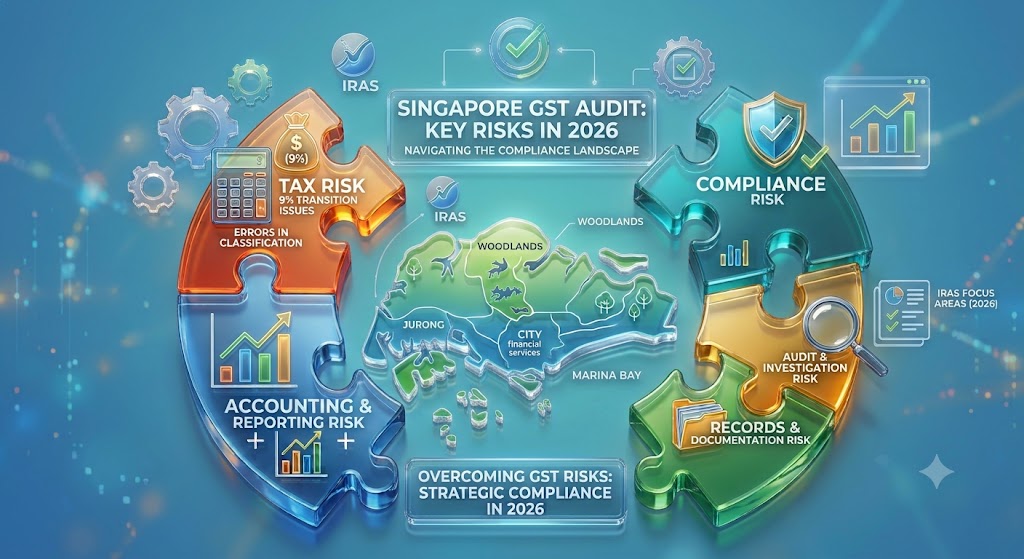
Singapore GST Audit: Key Risks in 2026
A Singapore GST audit can identify accounting errors that businesses may not notice during their normal financial reporting process. In FY2025/2026, the Inland Revenue Authority of Singapore (IRAS) completed more than 2,700 GST audits across different industries and recovered S$226 million in taxes and penalties. These results show why businesses should review their GST reporting, accounting records and internal controls regularly.
For companies operating in Singapore, good GST management involves more than submitting returns on time. Businesses also need accurate accounting records, appropriate supporting documents and effective processes for reviewing taxable transactions.
Why Singapore GST Audit Risks Matter in 2026
IRAS uses a risk-based approach when selecting businesses for GST audits. Any GST-registered business can face GST errors and penalties, regardless of its size or business structure.
Recent IRAS cases highlight several areas that deserve attention:
- Incorrect GST treatment of revenue
- Errors involving credit notes
- Incorrect treatment of related-party transactions
- Unsupported input tax claims
- Missing accounting records
- Incorrect GST coding
- Errors involving overseas transactions
- Weak internal controls
Therefore, businesses should identify potential problems before an IRAS review takes place.
Singapore GST Audit Findings: Common Accounting Errors
Recent IRAS audit cases provide practical examples of how accounting mistakes can create significant GST exposure.
1. GST Not Accounted for on Performance-Based Fees
One fund management company charged GST on its fixed management fees but did not account for GST on performance-based fees.
IRAS determined that the performance-based fees formed part of the consideration for the company’s fund management services. Following the audit, IRAS recovered close to S$6.5 million in GST and penalties.
The case shows why businesses should review different revenue streams instead of assuming that similar services always have the same accounting treatment.
Businesses should also reconcile revenue in their financial statements with taxable supplies reported in GST returns. Differences can indicate errors that require further review.
2. Incorrect Credit Notes
Another business issued credit notes for internal cost adjustments relating to unsold inventory. The credit notes did not relate to original tax invoices or actual sales transactions.
As a result, the company understated its output tax by S$8.1 million. IRAS recovered the under-declared GST and imposed a S$49,000 penalty.
Businesses should therefore issue credit notes only when they have a genuine reason to adjust an earlier supply. They should also keep the relevant invoices and supporting documents.
3. Related-Company Transactions
A third company transferred inventory in Singapore to a related company during a group restructuring.
The company treated the transfer as an internal transaction. However, the transfer took place between separate legal entities and constituted a taxable supply for GST purposes.
Following the IRAS audit, more than S$3.2 million in GST and penalties was recovered.
This case demonstrates why companies should review intercompany transactions carefully. A transaction does not automatically fall outside GST rules simply because two businesses belong to the same group.
Singapore GST Audit Risks for Input Tax Claims
Input tax claims also require careful attention.
IRAS recently identified cases where businesses claimed input tax without sufficient evidence that the underlying transactions were genuine. In one case, a company could not provide complete details of its purchases and had suppliers that IRAS found were not carrying on genuine business activities. The company had to repay more than S$2.6 million in wrongfully claimed input tax and omitted output tax, together with penalties.
Businesses should therefore look beyond the tax invoice itself.
Before claiming input tax, accounting teams should consider:
- Whether the purchase actually took place
- Whether the purchase relates to the business
- Whether the supplier is genuine
- Whether the company has appropriate supporting documents
- Whether the GST treatment is correct
- Whether the transaction presents unusual commercial risks
IRAS states that tax invoices are necessary but are not sufficient on their own when the underlying transaction is not genuine.
How Accounting Records Can Support a Singapore GST Audit
Accurate accounting records give businesses a stronger foundation for GST reporting and audit preparation.
Businesses should maintain documents such as:
- Sales invoices
- Purchase invoices
- Credit notes
- Bank statements
- Accounting ledgers
- Contracts
- Import and export documents
- Supporting schedules
- Relevant transaction correspondence
IRAS requires businesses to maintain comprehensive and accurate business records for at least five years.
A well-organised record-keeping system also makes it easier for accounting teams to investigate differences between financial statements and GST returns.
For businesses looking to strengthen their internal GST processes, uSafe’s ASK Review Singapore for IRAS GST Compliance explains how an internal review can help identify GST errors, improve documentation and strengthen controls.
How to Prepare for a Singapore GST Audit
Businesses do not need to wait for an IRAS notice before reviewing their GST processes.
A practical internal review can include five steps.
Step 1: Reconcile Accounting Records
Compare revenue and purchase information in the accounting system with the GST return.
Investigate unexplained differences promptly.
Step 2: Review GST Coding
Check whether accounting software applies the correct GST codes to sales, purchases and adjustments.
Incorrect coding can affect GST returns even when the underlying transaction is legitimate.
Step 3: Check Input Tax Claims
Review high-value or unusual purchases and confirm that the company has sufficient evidence to support each claim.
Step 4: Review Intercompany Transactions
Identify transactions involving related companies and determine whether the correct GST treatment applies.
Step 5: Check Supporting Documents
Make sure invoices, credit notes, contracts and other relevant documents are available and properly organised.
Businesses can also use IRAS self-review tools to strengthen their internal processes. uSafe’s guide on GST compliance and IRAS self-review tools explains several practical checks businesses can perform.
What Businesses Should Do When They Find a GST Error
Finding a GST error does not necessarily mean that a business should wait for IRAS to discover it.
Businesses should first understand the nature and amount of the error. They can then assess whether a voluntary disclosure may apply.
IRAS states that voluntary disclosures can receive no penalty or lower penalties when they meet the relevant conditions.
Businesses should review their circumstances carefully and consider obtaining professional advice before making a disclosure.
If the issue relates to GST registration rather than an incorrect GST return, businesses can also review uSafe’s guide to GST Registration in Singapore for information about registration obligations and compliance risks.
How uSafe Supports Singapore Businesses
At uSafe, we help businesses improve their accounting and GST processes through structured financial reviews and compliance support.
Our support can include:
- GST health checks
- Accounting record reviews
- GST reconciliation
- Transaction reviews
- Supporting document checks
- Internal control reviews
- GST compliance support
- Audit preparation
- IRAS query support
A regular review can help management identify accounting differences, documentation gaps and GST treatment issues before they become larger compliance problems.
Build Better GST Controls Before an IRAS Review
Recent IRAS audit results show that GST errors can arise from ordinary business activities, including revenue recognition, credit notes, related-company transactions and input tax claims. In FY2025/2026, IRAS recovered S$226 million in taxes and penalties from more than 2,700 GST audits.
For Singapore businesses, the practical response is to build GST checks into normal accounting processes.
Regular reconciliation, accurate GST coding, proper documentation and review of unusual transactions can help businesses maintain stronger financial controls.
A Singapore GST audit should not be viewed only as a year-end concern. Instead, businesses can prepare throughout the year by keeping their accounting records accurate, complete and easy to verify.
Need help reviewing your GST and accounting processes in Singapore? Contact uSafe to discuss your business requirements.
Official Source
IRAS – Recent GST Audits by IRAS
Official Sources
- IRAS – Recent GST Audits
- IRAS – Current Areas of GST Audits
- IRAS – Overview of Audits
- IRAS – Input Tax Claims and Genuine Transactions



 Chinese
  English