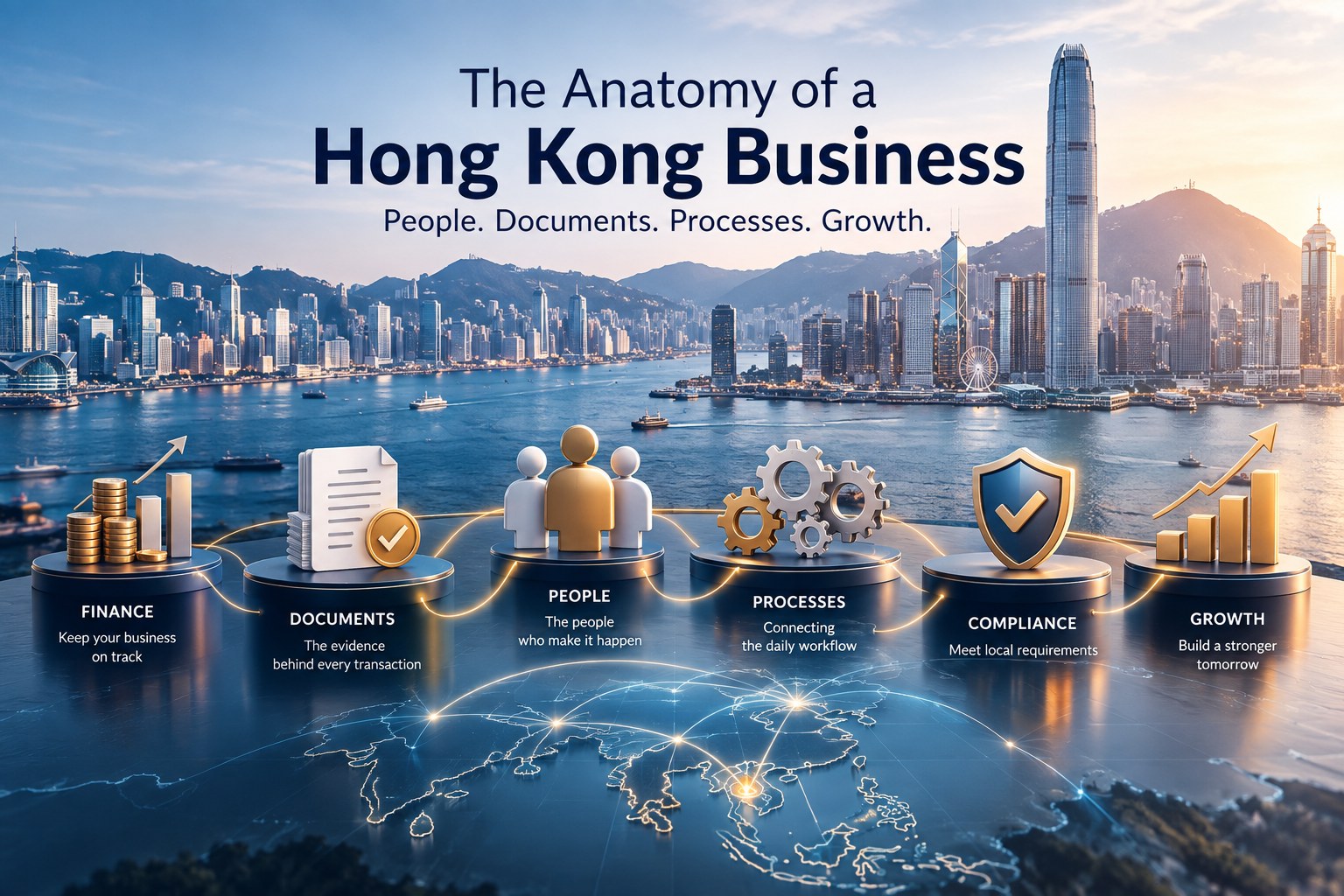
The Anatomy of a Hong Kong Business: How Operations Work
Running a business in Hong Kong involves much more than selling products or generating revenue. Behind every successful company, there is a network of people, documents, payments, processes and decisions working together.
In practice, Hong Kong business operations depend on how effectively these different elements connect. For international companies, this becomes even more important because a business may have customers in Hong Kong, suppliers in Mainland China and management teams across Asia.
Therefore, understanding the full structure of a business can help management identify gaps, improve visibility and support better decisions.
1. The Money: Where Business Activity Begins
Money is at the centre of every business. Sales generate revenue, while customers make payments and companies pay suppliers, employees and service providers.
However, transactions alone do not provide a complete picture. Management also needs to understand where money comes from, when customers are expected to pay and which expenses require attention.
For example, a business may need to monitor:
- Revenue and sales
- Customer payments
- Supplier payments
- Available cash
- Recurring expenses
- Outstanding balances
- Recorded transactions
As a result, financial visibility becomes an important part of Hong Kong business operations.
The objective is not simply to record transactions. Instead, the aim is to create information that management can use when making business decisions.
2. The Documents: The Evidence Behind Every Transaction
Every business transaction leaves a trail. An invoice can support a sale, while a contract can define commercial terms. Similarly, a bank statement can confirm a payment and supporting documents can explain why a transaction took place.
For this reason, document management should not be treated as an administrative afterthought.
A practical document structure can include:
- Sales invoices
- Purchase invoices
- Contracts
- Bank statements
- Payment records
- Expense documentation
- Payroll records
- Tax-related documents
- Management reports
Once these records are organised, daily operations become easier to manage. Moreover, teams can spend less time searching for information when they need to investigate a transaction or prepare documents.
For Hong Kong companies, statutory filing requirements also matter. The Companies Registry states that local companies are required to deliver annual returns, with the timing depending on the type of company. (Companies Registry)
3. The People: Who Keeps the Business Moving?
Technology can automate many tasks, but people still make business decisions.
A typical company may involve:
- Founders and directors
- Finance teams
- Sales teams
- Operations staff
- External accountants
- Auditors
- Banks
- Suppliers
- Customers
- Professional advisers
Each group may hold different information. For instance, the sales team may know which customers are waiting for invoices, while the finance team knows which invoices remain unpaid.
Meanwhile, management may have a different view of cash flow from the operational team. Consequently, communication between teams is just as important as the systems they use.
Clear responsibilities can therefore help prevent duplicated work, missing documents and unnecessary delays.
4. The Operations: Connecting the Daily Workflow
This is where the different parts of a business come together.
Consider a simple customer transaction:
Customer order → Sales invoice → Payment → Bank reconciliation → Record update → Management reporting
Each step depends on the previous one. If the invoice is missing, for example, the payment may become difficult to match.
Similarly, if the payment is not reconciled, the financial records may become unclear. Eventually, incomplete records can affect management reporting.
That is why strong Hong Kong business operations require connected processes rather than isolated tasks.
A simple workflow can make responsibilities easier to understand. At the same time, it can help teams identify problems earlier.
5. The Control: Knowing What Is Happening
Business control does not mean creating unnecessary bureaucracy. Instead, it means knowing whether important processes are working as expected.
For example, management may want to know:
- Are major transactions properly supported?
- Are customer payments being followed up?
- Are supplier balances accurate?
- Are bank accounts reconciled regularly?
- Are important documents easy to locate?
- Are unusual transactions being reviewed?
- Is management receiving information on time?
These questions create visibility. More importantly, simple controls can help identify issues before they become larger operational problems.
Therefore, control should be viewed as a practical part of everyday business management.
6. The Hong Kong Compliance Layer
Hong Kong businesses also operate within a formal regulatory environment.
The Companies Registry provides requirements and filing information for companies operating in Hong Kong. For example, a local private company generally needs to deliver its annual return within 42 days after the anniversary of its incorporation. (Companies Registry)
In addition, the Companies Registry provides an electronic filing and reminder service for annual returns. (Companies Registry)
This means compliance should be considered part of the operating structure rather than something handled only at the end of the year.
Nevertheless, requirements can differ depending on a company’s structure and circumstances. Businesses should therefore check the applicable requirements with the relevant authority or professional adviser.
7. The Reporting Layer: Turning Data Into Decisions
Data becomes valuable when people can understand it.
Management reporting can bring together information such as:
- Revenue
- Expenses
- Cash position
- Receivables
- Payables
- Outstanding items
- Monthly performance
- Key operational issues
Instead of reviewing hundreds of individual transactions, management can use structured reports to identify important movements.
Furthermore, consistent reporting can make it easier to compare performance over time.
For a growing company, this becomes increasingly important. As the business gains more customers, transactions and suppliers, additional activity can also create additional complexity.
Without a clear reporting structure, management may spend more time collecting information and less time using it.
8. When One Hong Kong Business Becomes Regional
The operating model becomes more complex when a Hong Kong company expands into other Asian markets.
For example, a group may have operations across:
Hong Kong → Singapore → Malaysia → Other Asian markets
Each market can have different regulations, currencies, banking arrangements and business practices.
At the same time, management may still need one overall view of the group.
Therefore, regional businesses need two things:
Local accuracy + regional visibility
Local teams can maintain market-specific information. Meanwhile, management can use standardised reporting and processes to understand the wider business.
As a result, a well-designed operating framework can make regional expansion easier to manage.
9. Building a More Connected Business
A connected business does not necessarily require a complicated system.
Often, the starting point is much simpler:
- Define who is responsible for each process.
- Standardise important documents.
- Create consistent transaction workflows.
- Reconcile financial information regularly.
- Establish clear reporting deadlines.
- Review unusual or incomplete items.
- Give management timely information.
Once these foundations are in place, technology can help automate repetitive tasks.
However, technology should support a good process rather than replace one. In other words, better tools work best when the underlying workflow is already clear.
10. The Bigger Picture
The anatomy of a Hong Kong business can be viewed as a connected structure:
People
↓
Processes
↓
Documents
↓
Transactions
↓
Financial information
↓
Management decisions
When these elements work together, management can see the business more clearly.
On the other hand, when one part is disconnected, problems can appear elsewhere. For example, a missing document can affect reporting, while a delayed reconciliation can reduce financial visibility.
Ultimately, strong Hong Kong business operations are about connection, consistency and visibility.
FAQ
What are Hong Kong business operations?
Hong Kong business operations refer to the daily processes that keep a company running, including sales, payments, documentation, finance, people, reporting and compliance.
Why are business operations important in Hong Kong?
Well-organised operations can improve visibility, reduce duplicated work and help management make decisions using reliable information.
What documents should a Hong Kong business organise?
Depending on the business, important documents can include invoices, contracts, bank statements, payment records, expense documents, payroll records and tax-related information.
Does every Hong Kong company have the same filing requirements?
No. Requirements can vary depending on the type and circumstances of the company. Therefore, businesses should check the applicable requirements with the Hong Kong Companies Registry or another relevant authority.
How can businesses prepare for regional expansion?
Businesses can start by standardising processes, defining responsibilities, organising documentation and creating consistent reporting across markets.
Conclusion
A Hong Kong business is more than its revenue, employees or products.
Instead, it is a connected system of people, documents, transactions, processes and decisions.
By understanding this structure, management can identify where information is created, where it moves and where problems may occur.
For companies operating across Asia, this perspective becomes even more important. Ultimately, a clear operating structure can provide the foundation for better visibility, smoother processes and sustainable growth.

 Chinese
  English