Singapore Compliance Calendar 2026: A Practical Guide for Businesses
Running a company in Singapore involves more than managing daily operations. Directors also need to monitor corporate filings, tax deadlines, accounting records, and other regulatory responsibilities.
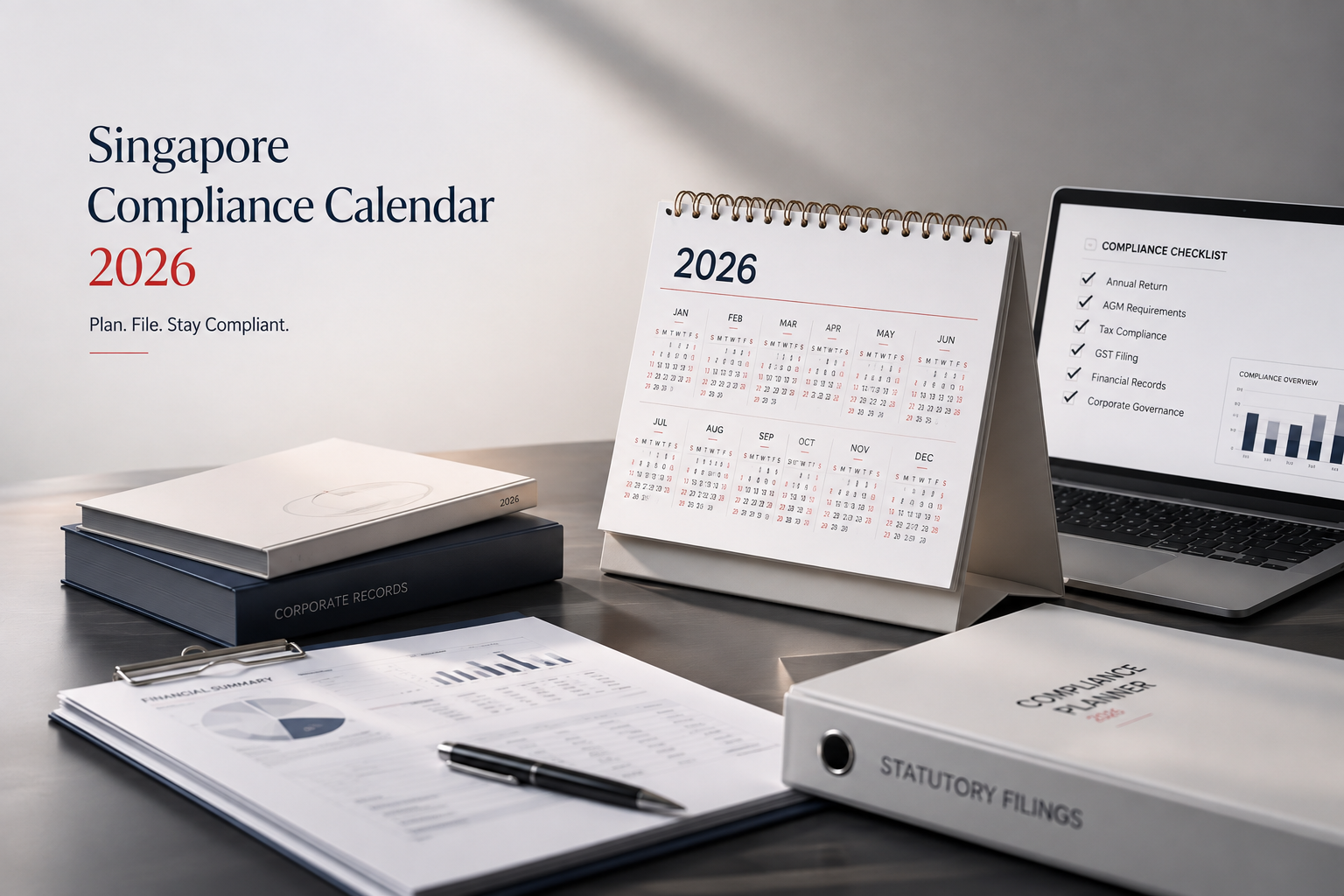
A Singapore compliance calendar 2026 gives businesses a practical way to organise these obligations. Instead of reacting to deadlines at the last minute, management can plan each task, prepare documents, and assign responsibilities in advance.
However, every company follows a slightly different schedule. The financial year end (FYE), company type, GST registration, and tax position can all affect the deadlines that apply.
This guide explains the main compliance areas that Singapore businesses should monitor in 2026. It also shows how a simple calendar can help directors stay organised throughout the year.
Important: This article provides general information. Your company’s actual obligations may differ. Always check the latest requirements with ACRA and IRAS.
Why Use a Singapore Compliance Calendar?
Corporate compliance often involves several separate deadlines. Without a clear system, directors may overlook an important filing or leave document preparation too late.
A calendar brings these responsibilities together.
For example, the Annual Return requires companies to provide important corporate information to ACRA. Tax filing, meanwhile, depends on accurate accounting records and tax computations.
A coordinated schedule gives the finance team enough time to prepare financial information. At the same time, directors can review important documents before submission.
As a result, businesses can reduce last-minute pressure and improve their internal compliance process.
Start With Your Financial Year End
The financial year end should form the starting point of your compliance calendar.
ACRA defines the FYE as the last day of a company’s accounting period. Companies can choose their FYE, with 31 March, 30 June, 30 September, and 31 December among the common choices.
The FYE directly affects important corporate deadlines. It determines when a company must hold its AGM and when it must file its Annual Return.
Consider a private company with a 31 December 2025 FYE. ACRA’s example gives the company an AGM deadline of 30 June 2026 and an Annual Return deadline of 31 July 2026.
Therefore, directors should confirm the FYE before creating the rest of the calendar.
Key Compliance Deadlines for 2026
Several obligations deserve a place on most Singapore companies’ annual schedules.
| Compliance area | Main timing |
|---|---|
| AGM | Based on FYE and company type |
| Annual Return | Based on FYE and company type |
| ECI | Generally within 3 months after FYE |
| Corporate Income Tax Return | 30 November 2026 |
| GST Return | Generally 1 month after the accounting period |
| Accounting records | Maintain throughout the year |
| Financial statements | Prepare according to applicable requirements |
These dates provide a useful framework. Nevertheless, directors should confirm the specific deadlines for their own company.
January: Review Your Compliance Position
January provides a good opportunity to review the previous year’s compliance work.
Start by checking the company’s FYE and upcoming deadlines. Then, review any outstanding ACRA or tax matters from the previous year.
Corporate information also deserves attention. Check the registered office, directors, company secretary, shareholders, and other relevant records.
At the same time, review the accounting system. Missing invoices, unreconciled bank transactions, or incomplete supporting documents can cause problems later.
An early review gives the business time to correct these issues before the next filing period.
February: Organise Accounting Records
Accurate accounting records support almost every major compliance task.
During February, review invoices, receipts, bank transactions, payroll information, and other financial documents. Reconcile important accounts and investigate unusual balances.
For instance, an unexplained bank difference may indicate a missing transaction. Finding the problem early gives the finance team more time to investigate it.
In addition, review outstanding customer invoices and supplier balances.
A regular accounting review can therefore improve both financial reporting and tax preparation.
March: Check Your ECI Requirement
Estimated Chargeable Income, or ECI, represents another important corporate tax responsibility.
Generally, companies must file ECI within three months from the end of their financial year unless they qualify for an applicable waiver. IRAS also states that a company may still need to file ECI if it does not receive a notification but fails to meet the exemption conditions.
For example, a company with a 31 December 2025 FYE would generally review its ECI obligation during the first quarter of 2026.
Early filing can also provide tax payment advantages for qualifying companies. IRAS explains that companies can receive more instalments when they file earlier and meet the relevant GIRO conditions.
Consequently, businesses should review ECI before the deadline rather than treating it as a last-minute task.
April: Review Financial Information
Once the accounting records are organised, management can focus on financial reporting.
Review revenue, expenses, receivables, payables, fixed assets, loans, and cash balances. Significant transactions should also have appropriate supporting documents.
Meanwhile, businesses that need audit services can start preparing the information that auditors may request.
This preparation can save time later. It also gives directors an opportunity to investigate unusual transactions before the company completes its financial reporting.
Furthermore, accurate financial statements help management understand the company’s financial position.
May: Prepare for AGM and Annual Return
May can become an important preparation month for companies approaching their AGM and Annual Return deadlines.
ACRA generally requires non-listed companies to hold an AGM within six months after the FYE. Listed companies generally have four months. Certain private companies may qualify for an exemption or may choose to dispense with the AGM under the applicable rules.
Therefore, directors should confirm which requirement applies to their company.
The Annual Return also requires careful preparation. ACRA states that companies must file an Annual Return each year while they remain live, including inactive or dormant companies.
Use this preparation period to review corporate information and financial documents.
June: Complete the AGM Process
For a non-listed company with a 31 December 2025 FYE, June normally marks the AGM deadline.
During the AGM, the company presents its financial statements to shareholders. Shareholders can also ask questions and address concerns about the business.
Not every private company needs to hold a physical AGM. A private company may qualify for an exemption or choose to dispense with its AGM if it meets the relevant requirements.
For that reason, directors should review the applicable rules before arranging the meeting.
After completing the AGM process, keep the relevant records and resolutions properly.
July: File the Annual Return
July becomes particularly important for a company with a 31 December FYE.
ACRA generally gives non-listed companies seven months after the FYE to file their Annual Return. For a company with a 31 December 2025 FYE, the normal deadline falls on 31 July 2026.
Before filing, review the company’s information carefully.
The Annual Return includes information such as the company name, business activities, registered office, directors, company secretary, members, share information, and financial statements where applicable.
Accuracy matters because the filing keeps the company’s public information current.
Late filing can also create additional costs. ACRA currently applies a S$300 penalty for filing up to three months late and S$600 for filing more than three months late. More serious enforcement action may also apply.
Therefore, businesses should aim to complete the Annual Return before the deadline.
August: Review the First Half of the Year
August offers a useful opportunity to review the company’s compliance process.
Ask whether the business completed its filings on time. Then, identify any tasks that caused delays.
Perhaps the finance team struggled to collect documents. Maybe one person handled too many compliance responsibilities. Alternatively, management may have discovered that internal records needed improvement.
These observations can help the company improve its process.
A short mid-year review can therefore prevent the same problems from appearing again.
September and October: Prepare for Corporate Tax
The final quarter should not begin with a last-minute tax exercise.
Instead, use September and October to prepare financial information and tax documents.
Review revenue, expenses, fixed assets, supporting records, and tax adjustments. At the same time, check whether the figures in the tax computation agree with the financial statements.
IRAS requires companies to file Form C-S, Form C-S (Lite), or Form C by 30 November each year.
Consequently, October provides an excellent opportunity to complete most of the preparation before the final filing month.
November: File Corporate Income Tax
November is one of the most important tax months in the Singapore compliance calendar.
IRAS requires companies to file their Corporate Income Tax Return by 30 November 2026 for the 2026 filing year.
The appropriate return depends on the company’s circumstances. Businesses may use Form C-S, Form C-S (Lite), or Form C.
Before submitting the return, compare the tax computation with the financial statements. Review supporting schedules as well.
Finally, retain the filing acknowledgement and relevant records.
Businesses that miss the deadline can face enforcement action. IRAS may issue an estimated Notice of Assessment, impose a composition amount, or take further recovery action.
GST: Track Recurring Deadlines
GST-registered businesses need to monitor recurring GST obligations throughout the year.
IRAS provides specific GST filing dates according to the company’s accounting period. For example, the 2026 due-date schedule includes GST filing deadlines on 31 January, 30 April, 31 July, and 31 October for relevant quarterly periods.
Therefore, businesses should add each GST deadline to their calendar.
Before filing, reconcile output tax and input tax. Then, review tax invoices and supporting records.
A regular review can help identify errors before the filing deadline.
December: Close the Year and Plan Ahead
December provides a natural point for a year-end compliance review.
First, check whether the company has completed all required filings. Next, identify outstanding accounting, tax, or corporate matters.
The management team should also review the compliance process itself.
What caused delays? Which tasks required additional support? Did the company maintain accurate records throughout the year?
Once you answer these questions, create the 2027 compliance calendar.
Planning ahead gives the business a stronger starting point for the next financial year.
Common Compliance Mistakes to Avoid
Several simple mistakes can create unnecessary compliance problems.
Ignoring the FYE
The FYE determines important ACRA deadlines. Therefore, every company should keep this date clearly recorded.
Confusing Annual Return With Tax Filing
The Annual Return goes to ACRA, while corporate tax returns go to IRAS. Filing one does not replace the other.
Assuming Dormant Means Exempt
A dormant company may still need to file its Annual Return. ACRA specifically states that live inactive and dormant companies must continue filing unless the applicable requirements provide otherwise.
Waiting Until the Deadline
Last-minute preparation leaves less time to correct errors. Instead, businesses should prepare important documents several weeks ahead.
Forgetting GST Dates
GST-registered businesses should track each accounting period separately. A single annual reminder is not enough.
How uSafe Can Help
Managing corporate compliance internally can become difficult as a business grows.
Directors may need to coordinate accounting, audit, tax, corporate secretarial work, financial reporting, and statutory filings.
uSafe can help businesses organise these areas through professional accounting, audit, tax, and corporate compliance support.
A structured approach also gives directors better visibility over upcoming responsibilities.
Instead of managing every deadline separately, businesses can build one coordinated process around their FYE and regulatory obligations.
As a result, management can spend less time chasing documents and more time focusing on business operations.
Singapore Compliance Calendar 2026: Final Checklist
Before closing the year, review these areas:
- Confirm the company’s FYE.
- Check AGM requirements.
- Monitor the Annual Return deadline.
- Review ECI requirements.
- Prepare the Corporate Income Tax Return.
- Track GST filing dates where applicable.
- Maintain accurate accounting records.
- Organise financial statements and supporting documents.
- Resolve outstanding compliance matters.
- Prepare the 2027 compliance calendar.
This simple review can help directors maintain better control over corporate responsibilities.
Conclusion
A Singapore compliance calendar 2026 gives businesses a practical way to manage important corporate and tax responsibilities.
The best starting point is the company’s FYE. From there, directors can add AGM, Annual Return, ECI, Corporate Income Tax, GST, accounting, and internal review tasks.
However, no general calendar can replace a company-specific compliance review. Company type, FYE, GST registration, and tax circumstances can all affect the obligations that apply.
Therefore, businesses should verify their actual deadlines with ACRA and IRAS.
With early preparation, accurate records, and professional support when necessary, Singapore businesses can reduce last-minute pressure and build a more reliable compliance process throughout 2026.
Need help with accounting, audit, tax, or corporate compliance in Singapore? Contact uSafe to discuss how your business can manage its compliance responsibilities more efficiently.
Official Sources
- ACRA – AGM due dates and requirements
- ACRA – Annual Return deadlines and requirements
- ACRA – Choosing a company’s Financial Year End
- ACRA – Late Annual Return filing penalties
- IRAS – Estimated Chargeable Income filing
- IRAS – Corporate Income Tax filing
- IRAS – 2026 tax due dates


 Chinese
  English